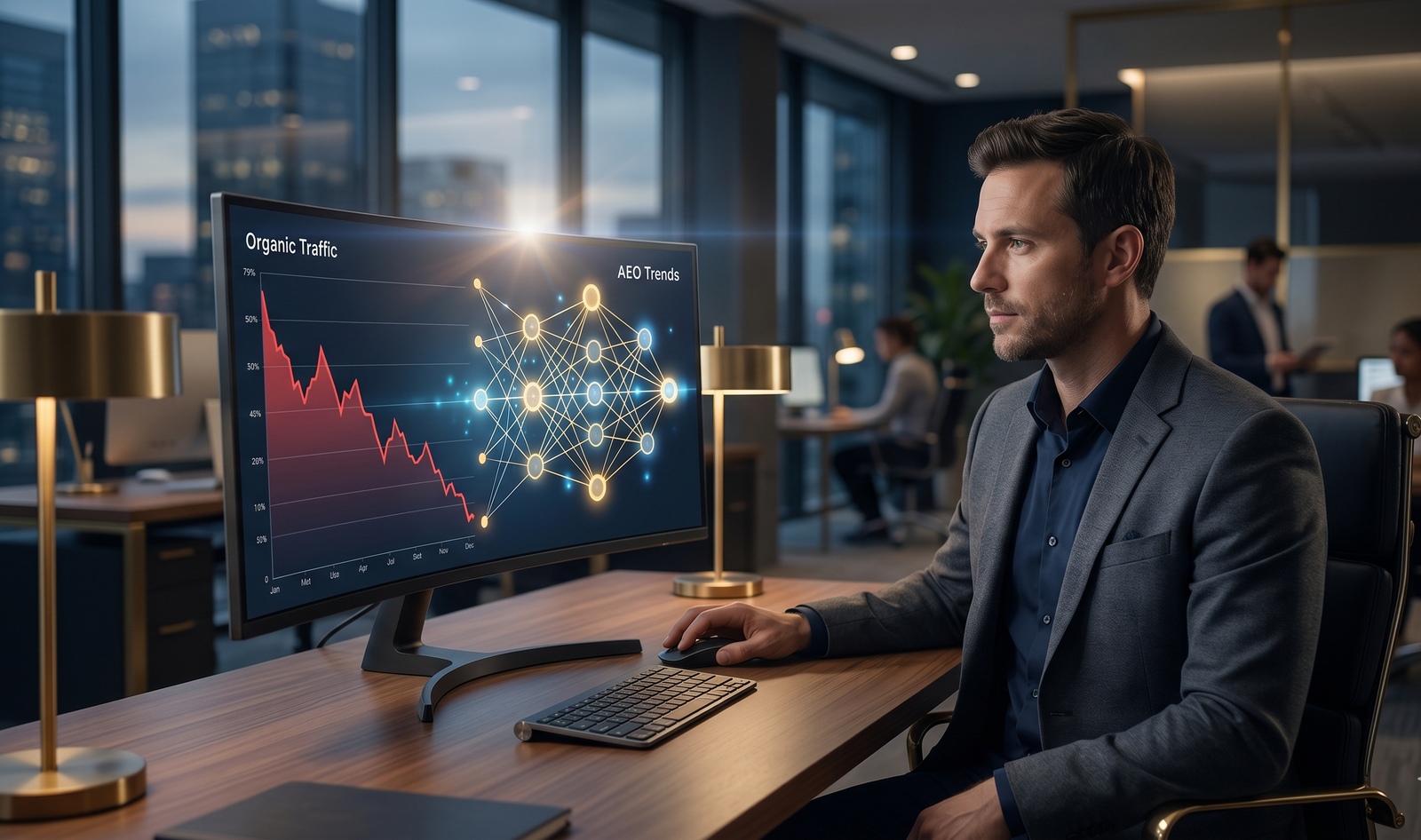
It's Monday. You open your laptop, pull up the analytics dashboard, and the rankings look fine. Page one for three of your top keywords. The SEO agency sent a green report last week. Everything looks like it's working. But understanding AEO trends 2026 is now the difference between brands that are found and brands that are quietly becoming invisible. So why is organic traffic down, again?
You bring it up in the team meeting. Someone blames the algorithm. Someone else suggests posting more on Instagram. The conversation goes in circles, and nothing gets resolved.
Here's what nobody in that meeting said out loud, because most teams haven't connected the dots yet: your potential customers aren't typing into Google the way they used to. They're asking AI. And AI is answering them, without ever sending them to your website.
This isn't a traffic blip. It's a structural shift. And it's been quietly happening while most brands were busy optimising for a game that's already changed.
The SEO Shift Nobody Officially Announced
There was no industry memo. No Google update with a dramatic name. But somewhere between 2024 and 2026, the first stop for information moved.
People started asking ChatGPT which CRM to buy. They asked Perplexity which marketing agency in Gurgaon has good reviews. They asked Google's AI Overview whether a product was worth it, and got a direct answer before they even saw a single link.
The search engine hasn't disappeared. But it's no longer the only gatekeeper between your brand and your customer. AI tools have stepped in as the new first responders to every question your buyer is asking, and they don't hand out a list of ten blue links. They give one consolidated answer, drawn from sources they've decided to trust.
If your brand isn't one of those sources, you don't exist in that conversation.
What Exactly is AEO?
Think of it this way. SEO was about getting your book into the library so people could find it on the shelf. AEO is about getting your book quoted by the librarian when someone walks in and asks a question.
Same library. Different game.
Answer Engine Optimization is the practice of structuring your content so that AI tools, ChatGPT, Perplexity, Google AI Overviews, and Gemini can easily read it, trust it, and cite it as the answer to what someone just asked. It's not about rankings anymore. It's about being the source AI points to when your customer makes a decision.
AEO Trends 2026: What's Already Happening Right Now
These aren't predictions. They're already shaping which brands show up in AI-driven search, and which ones don't.
- Answer-First Content
AI rewards clarity, not cleverness. Content that gets cited is content that gets to the point, answers the question directly, and doesn't make the reader, or the algorithm, work too hard to extract meaning. If your blogs are built around sounding impressive rather than being genuinely useful, they're likely to be skipped over entirely.
- Content Freshness
Stale content is invisible content. AI tools actively favour sources that are regularly updated. Brands leading in AEO are revisiting and refreshing their content at least once a quarter — not because of vanity, but because outdated information signals to AI that you're not a reliable source.
- E-E-A-T Signals — Credibility Over Keywords
Experience, Expertise, Authoritativeness, Trustworthiness. These signals matter more than keyword density ever did. AI tools are looking for content backed by real expertise, genuine experience, and sources that the broader internet trusts. Writing a lot is no longer enough. Writing with authority is what gets you cited.
- PR is Now a Search Strategy
This one surprises most brands. Over 80% of links cited by AI tools come from earned media, news coverage, third-party blogs, and industry publications. Your owned content alone won't cut it. If credible external sources aren't talking about your brand, AI tools have very little reason to trust it.
- Your Search Footprint is Bigger Than Your Website
Reddit threads, YouTube videos, industry forums, Quora answers, AI tools pull from all of it. Your brand's presence across these platforms is now part of your search strategy, whether you planned it that way or not. Being genuinely helpful in the places your audience already hangs out has become a legitimate visibility tactic.
- GEO — The Layer After AEO
Generative Engine Optimization is emerging alongside current AEO trends. Where AEO gets your content cited as the direct answer, GEO gets your content woven into the broader synthesised responses that AI generates. Think of AEO as getting quoted and GEO as shaping the narrative. Brands building both are the ones creating the strongest presence in AI search.
What Brands Are Getting Wrong Right Now
Let's be honest about what's actually happening out there.
Most brands are still writing for volume. More blogs, more pages, more content, without stopping to ask whether any of it is structured in a way that AI can actually extract and use. Quantity without clarity is just noise.
Many are still treating SEO and PR as completely separate departments with separate budgets and separate goals. In 2026, that divide is actively hurting visibility because AI doesn't separate them; it weighs both together when deciding what to trust.
Old content is being left to collect dust. A well-written piece from 2022 that hasn't been touched since is quietly losing relevance in AI systems that prioritise freshness. Revisiting your best existing content is often more valuable than publishing something brand new.
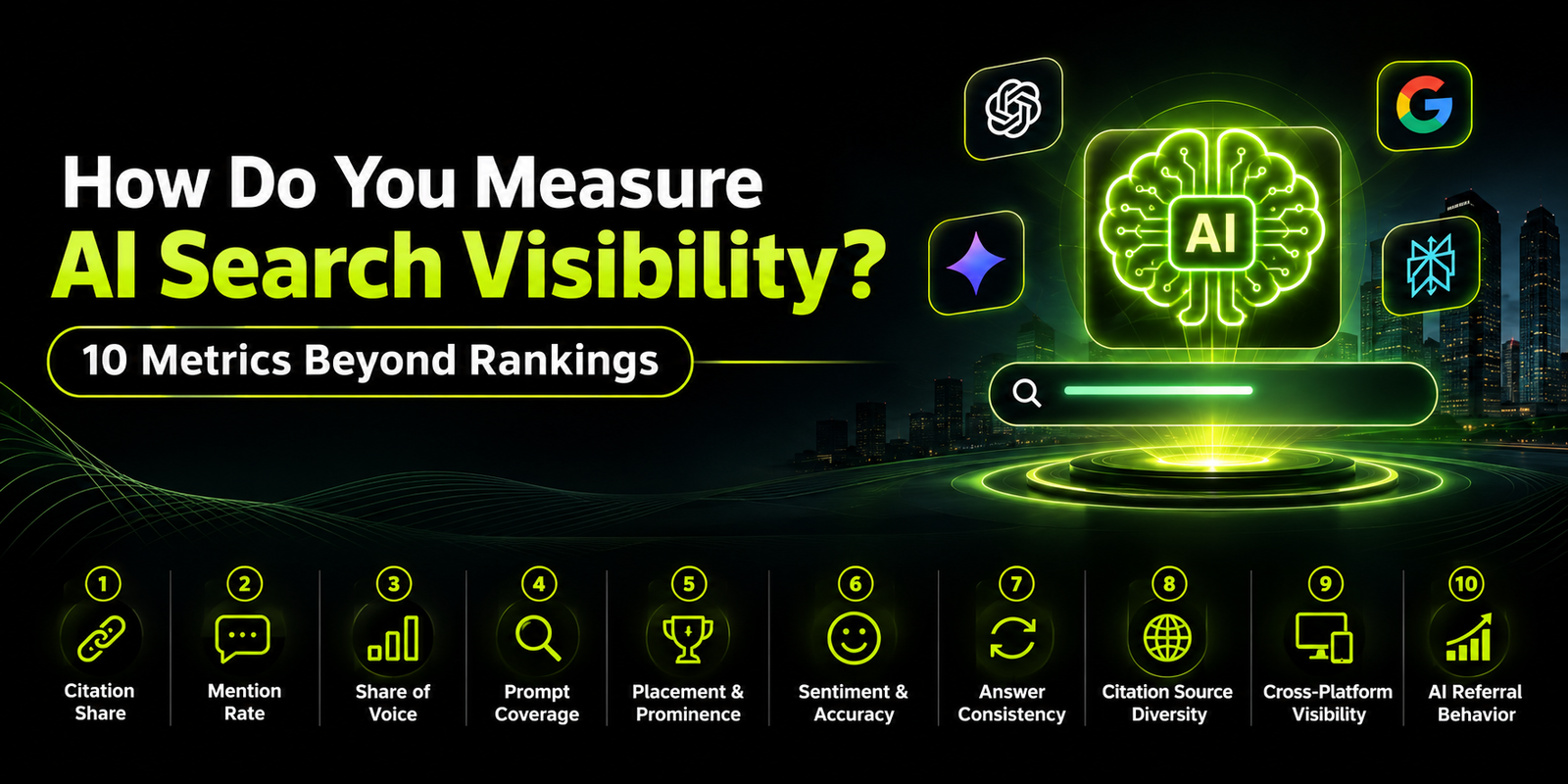
And most brands haven't even checked how they appear in AI search. They're optimising for a dashboard they can see, completely unaware of the conversation happening about them, or not happening, in the AI tools their customers use daily.
SEO Isn't Dead. It Just Got a Teammate.
Before you start questioning every decision your SEO team has made, don't.
SEO built the road. AEO gets you on the map that AI is reading. Everything you've invested in, site structure, backlinks, page speed, quality content, forms the foundation that AEO builds on top of. Brands panicking and throwing out their SEO strategy are making the same mistake as those ignoring AEO entirely.
The smartest approach in 2026 is integration. Let SEO keep your technical foundation strong. Let AEO shape how your content is structured and distributed. Let PR build the external credibility AI systems seek. These aren't competing strategies; they're chapters of the same playbook.
How Safal Media Helps Brands in Gurgaon Stay Ahead
If you're a brand based in Gurgaon or operating across the Delhi-NCR market, this shift is already affecting how your customers are finding, or not finding, you.
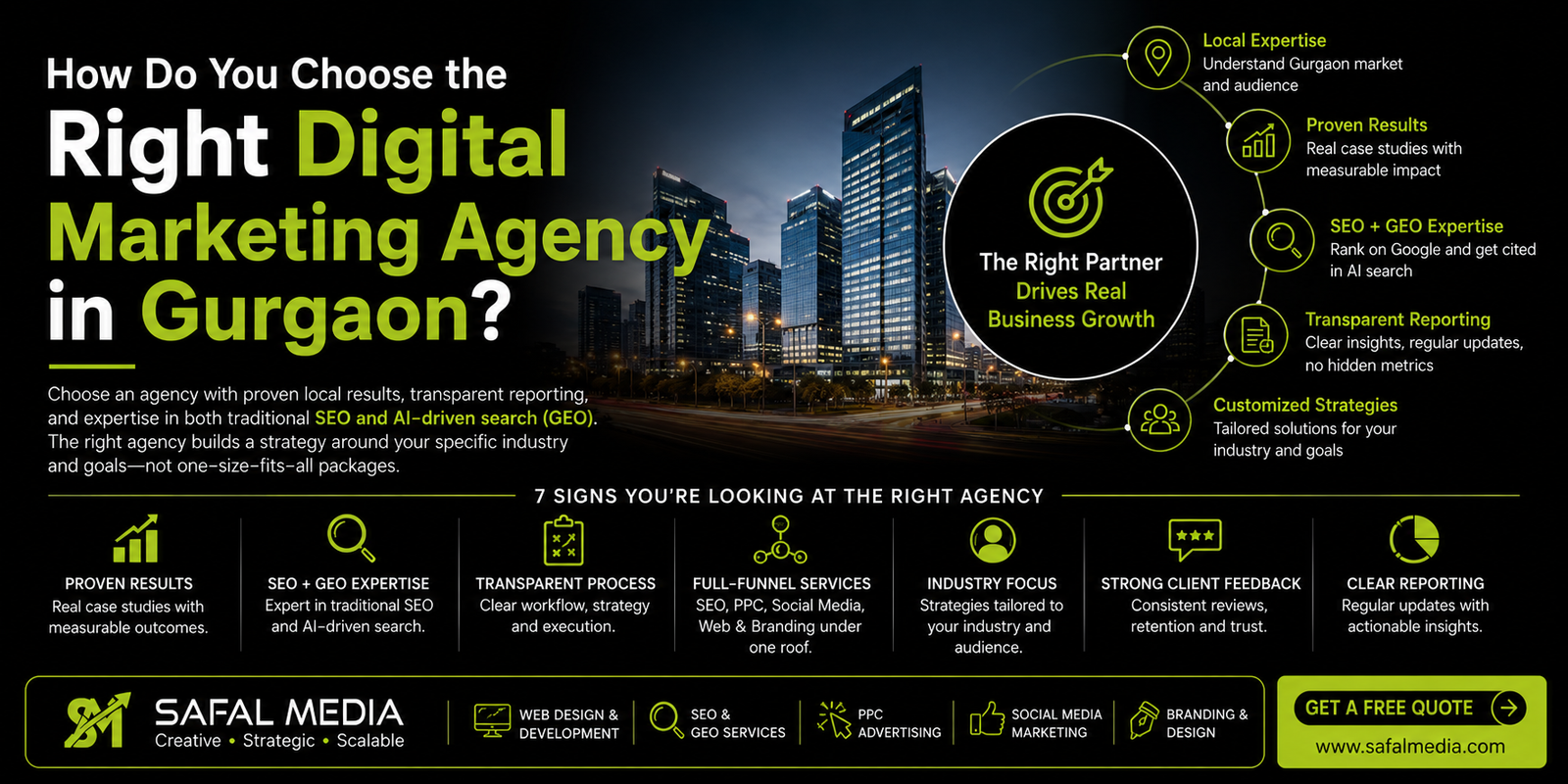
As a digital marketing agency in Gurgaon, Safal Media works with brands to close exactly that gap. From structuring content that AI tools actually cite, to building the kind of credibility that earns you a place in the answer and not just the search results, we approach it as one connected strategy, not a set of isolated tasks.
We don't hand you a generic content plan. We start by looking at where your brand currently stands in AI search, identify what's missing, and build from there. Because the goal isn't just visibility, it's being the brand that shows up when your customer is one question away from a decision.
What makes us one of the best digital marketing agencies for this moment is precisely that we don't separate SEO, AEO, content, and PR into silos, we build them as one integrated system, because that's the only way AI search rewards you.
Try This Right Now
Open ChatGPT or Perplexity. Search for your product category or the problem your business solves. See which brands show up. See how they're described. See what gets cited.
If your brand isn't in that answer, that's not a content volume problem. That's a strategy problem. And now you know exactly where to start.
The rules didn't disappear. They just got rewritten by something that doesn't care about your keyword density.
Conclusion: Start Acting on AEO Trends 2026- Before Your Competitors Do
The brands winning in AI search right now aren't necessarily the biggest or the most established. They're the ones who recognised the AEO trends of 2026 early, structured their content with clarity and authority, and built external credibility that AI tools could actually trust.
The window to get ahead isn't closing yet, but it is narrowing. If you're ready to stop optimising for yesterday's game and start building for how your customers actually search today, that's exactly the conversation worth having.