How AI Search Engines Choose Which Brands to Recommend
12
Feb
You type a question into ChatGPT or Google's AI Mode, and within seconds, a handful of brand names appear as recommendations. But have you ever wondered why those brands and not others? Why does one digital marketing agency show up consistently across AI platforms while another, equally capable one, remains completely invisible?
The answer isn't random. AI search engines follow a specific logic when deciding which brands to surface, cite, and recommend. Understanding that logic is the single most important step any business can take to improve its visibility in today's AI-first search landscape.
This blog breaks down exactly how AI search engines evaluate and recommend brands, and what you need to do to become one of them.
AI Search Is Not the Same as Google Search
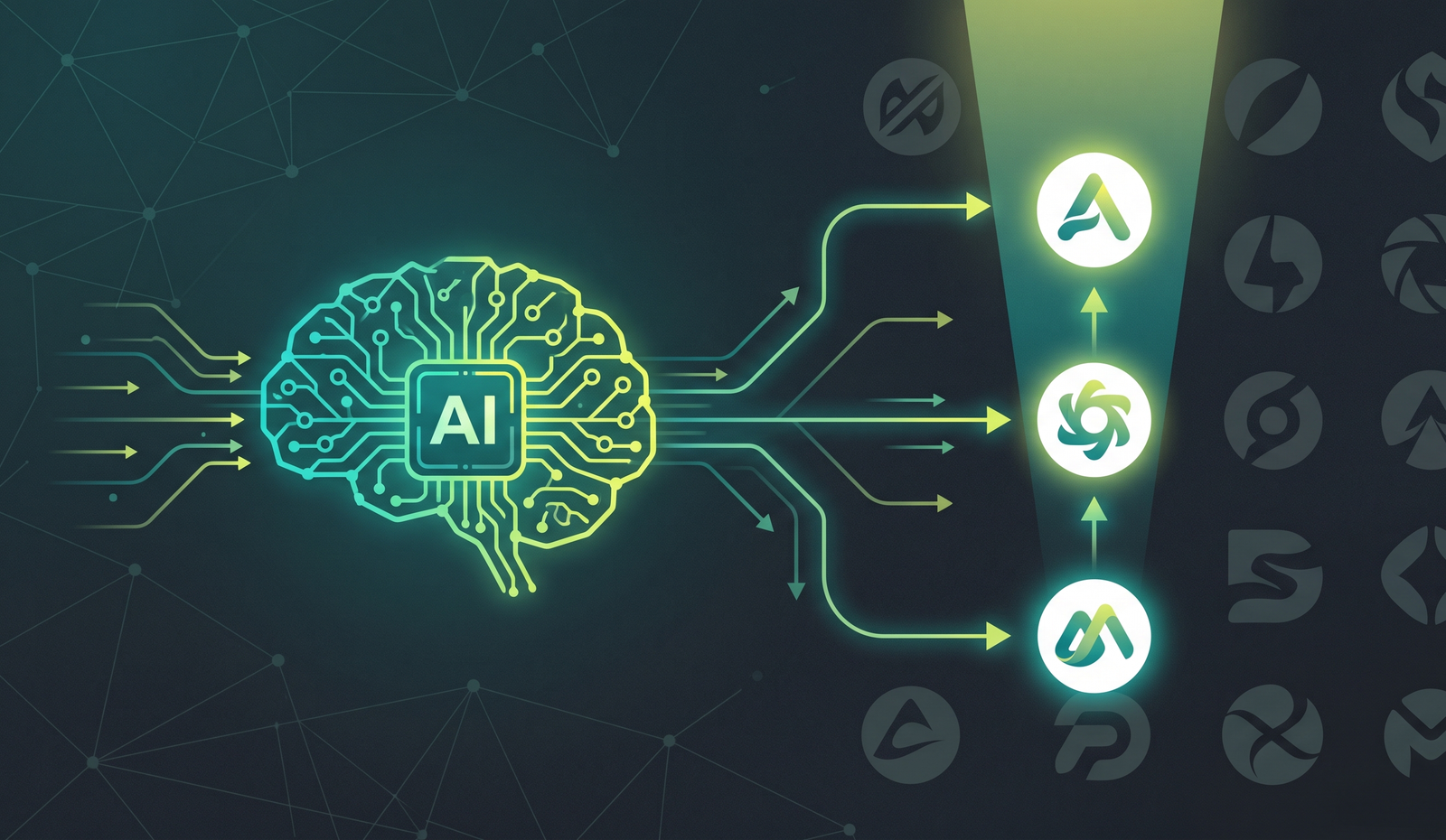
Before getting into the mechanics, it is important to separate AI search from traditional search. When you rank on Google, you are competing for a position on a list of ten blue links. When you rank in AI search, you are competing to be mentioned by name in a generated answer or left out entirely.
Platforms like ChatGPT, Perplexity, Google AI Overviews, and Gemini do not show you a page of options. They make a recommendation. That shift from listing to recommending is everything. It means brand trust, content authority, and digital footprint now matter more than keyword density and backlink volume alone.
The 5 Core Factors AI Search Engines Use to Recommend Brands
1. Content That Directly Answers Questions
AI search engines are built to answer questions. So the first thing they look for is content that does exactly that, clearly, confidently, and in a structured format.
Brands that get recommended have websites and blog content written in a question-and-answer format. Their service pages answer what they do, who they serve, why they are different, and what results they deliver. Their blogs address specific problems their audience is searching for.
If your website is filled with vague claims like "we deliver results" and "we are a passionate team," AI has nothing concrete to extract. It moves on to a competitor whose content actually answers the question.
For a business looking to be recommended as the best digital marketing agency in Gurgaon, the content needs to specifically address what digital marketing services are available in Gurgaon, who they are for, and what outcomes clients can realistically expect. Generic content does not get cited. Specific, helpful content does.
2. E-E-A-T Signals: Experience, Expertise, Authoritativeness, and Trust
Google introduced E-E-A-T as a quality evaluation framework, and AI search engines have adopted a similar logic when deciding which sources, and by extension which brands, to trust.
Experience means your content reflects real-world knowledge, not just theoretical information. Case studies, client outcomes, and behind-the-scenes process explanations all signal experience.
Expertise is demonstrated through depth. A brand that has published ten in-depth articles on performance marketing will outrank a brand with fifty shallow posts. AI systems can tell the difference.
Authoritativeness comes from being talked about by others. When third-party websites, industry publications, directories, and review platforms mention your brand, AI models treat that as a vote of confidence. The more credible the source, the stronger the signal.
Trust is built through consistency, accurate business information, real client reviews, transparent pricing or process information, and a professional online presence across all platforms.
Brands that score high on all four dimensions are far more likely to appear in AI-generated recommendations.
3. Third-Party Citations and Brand Mentions Across the Web
This is one of the most underestimated factors in AI search visibility. AI models do not just read your website. They process enormous amounts of data from across the internet, including Reddit threads, Quora answers, review platforms, YouTube comments, LinkedIn posts, news articles, and industry directories.
When your brand is mentioned consistently and positively across these sources, AI models begin to associate your name with authority in your category. This is what Generative Engine Optimization (GEO) is built around, earning the kind of distributed brand presence that AI systems can verify from multiple independent sources.
A brand mentioned on Clutch, featured in a marketing blog, discussed in a Reddit thread, and reviewed on Google Business Profile carries far more weight in AI recommendations than a brand that only exists on its own website.
The practical takeaway: stop thinking of content marketing as something that only happens on your own domain. Every mention elsewhere is a citation that trains AI to recommend you.
4. Structured Data and Schema Markup
AI crawlers read your website differently from humans. They are looking for structured signals that tell them what your business is, what it does, where it operates, and how credible it is.
Schema markup is the technical layer that provides those signals. The most important schema types for brand recommendations include:
- LocalBusiness schema: tells AI your business name, location, service area, and category
- FAQPage schema: feeds directly into AI answer extraction for question-based queries
- Service schema: defines individual offerings with descriptions, pricing context, and audience
- Review schema: surfaces aggregate ratings and testimonials as trust signals
Without a schema, AI crawlers have to guess at what your content means. With schema, you are handing them a clear, verified map of your brand. Businesses that implement schema correctly have a measurable advantage in appearing in AI Overviews and generative answers.
5. Topical Authority: Depth Over Breadth
AI search engines increasingly reward what is called topical authority, the idea that a brand which has comprehensively covered a subject area is more trustworthy than one that has touched on it briefly.
If you are a digital marketing agency, topical authority means having content that covers SEO, performance marketing, social media strategy, content marketing, analytics, and local marketing, not just a single page that lists your services. It means your blog, case studies, and resource pages together create a complete knowledge ecosystem around your area of expertise.
When an AI model encounters a query about digital marketing services, it scans its training data and live web index for the brand that has demonstrated the deepest, most consistent expertise on the topic. Shallow content spreads you thin. Deep content on a focused set of topics signals genuine authority.
How Answer Engine Optimisation (AEO) Feeds AI Recommendations
Answer Engine Optimisation is the practice of deliberately structuring your content to be extracted and cited by AI answer engines. It is not a separate discipline from the factors above; rather, it ties them together.
An AEO-optimised page anticipates the exact questions a user might ask an AI, structures answers in clean, extractable paragraphs, uses headers that mirror natural language queries, and includes an FAQ section that directly maps to high-intent prompts.
For example, a page optimised for the query "which digital marketing agency should I hire in Gurgaon" would include a clear definition of what to look for in an agency, a breakdown of service types, and specific answers to common objections, all structured so that an AI reading the page can lift the relevant section and use it as a confident recommendation.
This is the difference between passively hoping AI finds your content and actively engineering your content to be found.
What AI Search Engines Will Never Recommend
Just as important as what AI rewards is what it consistently ignores or penalises:
- Keyword-stuffed content written for old-school SEO with no real informational value
- Inconsistent business information across directories, platforms, and your own website
- Brands with no third-party presence, if no one else on the internet has ever mentioned you, AI has no external validation to rely on
- Websites that block AI crawlers, if your robots.txt prevents GPTBot or ClaudeBot from accessing your site, you simply do not exist to those platforms
- Overly promotional content with no educational value, AI is built to answer questions, not amplify sales pitches
The Brands That Win AI Search Are Building for It Intentionally
AI search is not a trend to watch from the sidelines. It is already the primary way a growing segment of buyers discovers, evaluates, and shortlists businesses. The brands showing up in those recommendations today are not there by accident; they are there because they have built content depth, earned third-party authority, implemented the right technical signals, and structured their digital presence for the way AI systems actually work.
For any business that wants to be known as the go-to choice, whether that is the best digital marketing agency in Gurgaon or the leading service provider in any other category, the question is no longer "How do I rank on Google?" It is "How does AI learn to recommend me?"
The answer starts with a content audit, a schema review, and a deliberate strategy to build the kind of authority that AI search engines are trained to trust.
How Safal Media Helps You Get Recommended by AI Search Engines
Safal Media is a results-driven digital marketing agency based in Gurgaon, specialising in AI search visibility, AEO, GEO, and content strategy for businesses that want to stay ahead of the curve. We help brands build the exact kind of digital authority, structured content, schema implementation, third-party citation networks, and topical depth that AI search engines are trained to trust and recommend. Whether you are a local business targeting Gurgaon or a brand with a pan-India presence, our team builds your visibility from the ground up, ensuring AI platforms not only find you but confidently recommend you over your competitors.
Conclusion
AI search engines are not guessing when they recommend a brand, they are following a clear, evaluable set of signals. Content that answers real questions, authority built across multiple platforms, structured data that speaks to crawlers, and deep topical expertise are what separate the brands that get recommended from the ones that stay invisible.
The good news is that this is not out of reach for any business. It requires intention, consistency, and the right strategy, not an unlimited budget or a decades-old domain. Businesses that start building AI-ready content and authority today will have a compounding advantage over those that wait.
The shift from Google rankings to AI recommendations is already underway. The only question is whether your brand is part of the answer, or missing from it entirely.
Frequently Asked Questions
Q1 How do AI search engines decide which brands to recommend?
AI search engines evaluate brands based on content quality, E-E-A-T signals, third-party citations, structured data, and topical authority. Brands with a strong, consistent presence across multiple trusted sources are more likely to be recommended.
Q2 What is the role of schema markup in AI brand recommendations?
Schema markup gives AI crawlers structured information about your business, what you do, where you operate, and how credible you are. It significantly increases your brand's chances of appearing in AI Overviews and generative answers.
Q3 How is AEO different from traditional SEO?
Traditional SEO focuses on ranking in a list of links. AEO focuses on being cited directly in AI-generated responses. Both share technical foundations, but AEO requires a stronger emphasis on question-based content formats and structured data.
Q5 Can a small business compete with larger brands in AI search?
Yes. AI search rewards content quality and topical depth over domain size. A focused, well-structured content strategy can help smaller brands outperform larger competitors on specific, high-intent queries.
Q6 How long does it take to appear in AI search recommendations?
With the right AEO and GEO strategy in place, most businesses begin seeing measurable improvements in AI visibility within 60 to 90 days. Broader topical authority builds over 6 to 12 months.