GEO vs SEO: What's the Difference and Why It Matters in 2026
30
May
What Is GEO in Marketing?
GEO stands for Generative Engine Optimization. It is the practice of structuring your content so that AI-powered platforms, Google AI Overview, ChatGPT, and Perplexity can find, understand, and cite your brand in their generated answers.
In simple terms: When someone asks an AI "Which is the best digital marketing agency in Gurgaon?" and the AI gives a direct answer without showing links, GEO is how your brand gets into that answer.
One important clarification: GEO is not the same as local or geographic SEO. Local SEO focuses on map pack and location-based rankings. GEO focuses entirely on AI visibility and citation.
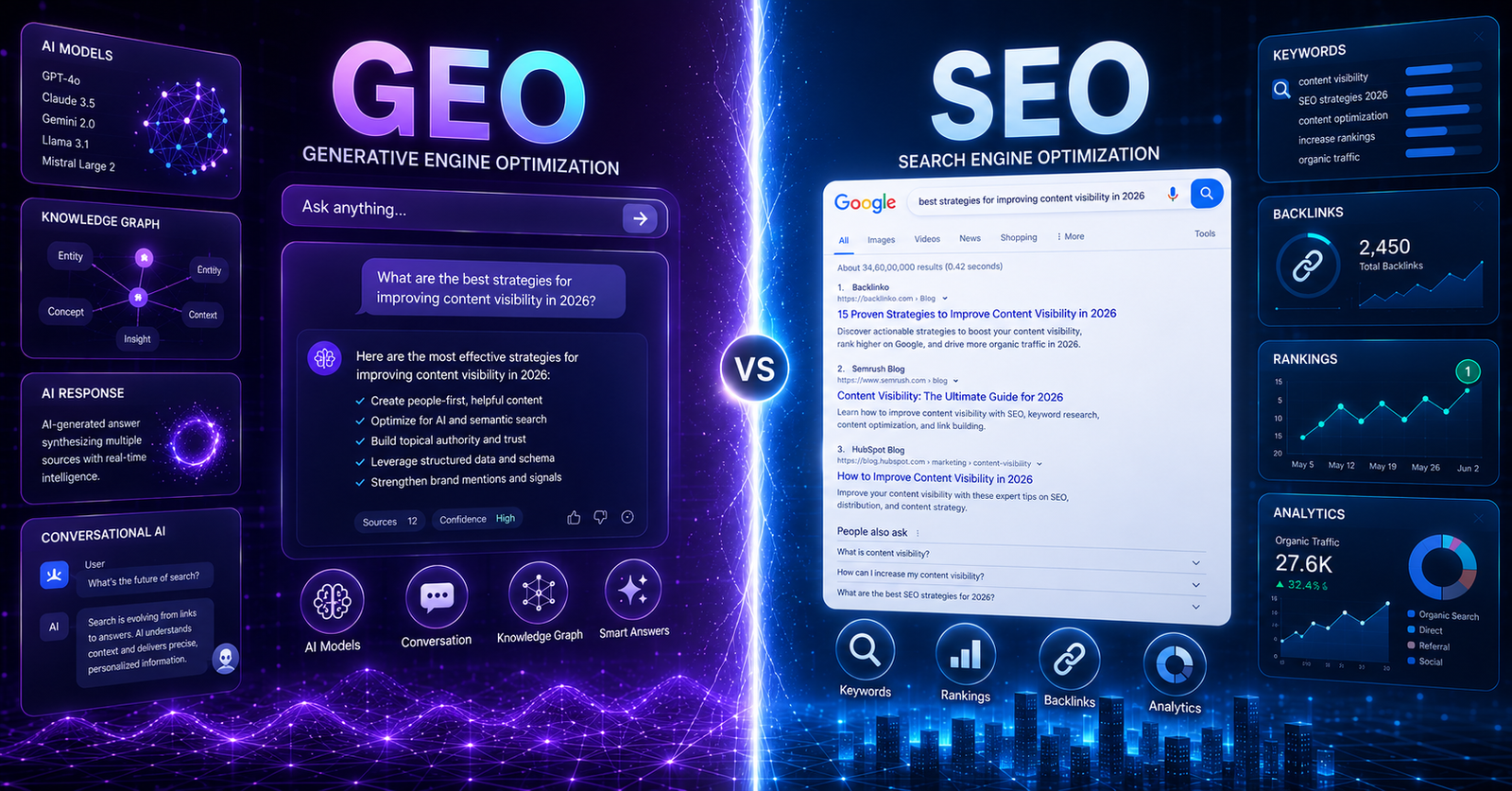
GEO vs SEO: What's the Actual Difference?
|
Factor |
SEO |
GEO |
|
Goal |
Rank on Google/Bing results pages |
Get cited in AI-generated answers |
|
Optimizes for |
Keywords, backlinks, crawlability |
Citability, clarity, topical authority |
|
Success metric |
Rankings and organic traffic |
Brand mentions inside AI responses |
|
Content that wins |
Keyword-rich, long-form articles |
Direct answers, definitions, data-backed facts |
|
User action |
User clicks your link |
User reads AI answer with your brand embedded |
The deeper difference: SEO targets algorithms that rank pages. GEO targets AI models that generate answers. Both audiences reward authority and quality, but they consume content in very different ways.
Does GEO Replace SEO?
No. GEO does not replace SEO. They serve different purposes and work best when combined as a strategy.
- SEO drives organic traffic through traditional search rankings, still essential since Google processes over 8.5 billion searches daily
- GEO builds AI-era visibility by getting your brand cited in generated answers, increasingly important as over 30% of all search interactions now happen through AI-powered interfaces, a number projected to exceed 50% by 2026 (Gartner)
- A combined GEO + SEO approach gives your brand full-spectrum presence across both channels
Why SEO Alone Is No Longer Enough
SEO has been the foundation of digital marketing for over two decades, and it still is. But search behaviour has shifted faster than most strategies have adapted:
- 60% of searches now end without a single click (SparkToro, 2024), users get their answer from AI Overviews or featured snippets directly on the results page
- AI Overviews on Google are expanding, absorbing informational queries before a user ever sees organic results
- ChatGPT, Perplexity, and Google Gemini now handle hundreds of millions of queries per week that would previously have driven traffic to websites
- Voice search continues to grow, with users expecting direct spoken answers rather than a list of links
The user who once clicked through five articles to research a topic now reads one AI-generated paragraph and moves on. SEO built the foundation. GEO is the layer that captures what SEO is starting to miss.
What GEO and SEO Have in Common
Rather than running two separate strategies, the smart move is to build one content framework that serves both. Several best practices improve your SEO rankings and GEO citations simultaneously:
E-E-A-T (Experience, Expertise, Authoritativeness, Trustworthiness)
Google has used E-E-A-T signals to evaluate content quality for years. AI models apply the same logic — they prefer sources that demonstrate genuine expertise and credibility. Building real authority in your niche rewards you in both channels.
Structured Data and Schema Markup
Schema markup helps Google's crawlers parse your content accurately. It also helps AI systems identify what type of content you're producing, an FAQ, a how-to, a product review, or a comparison guide.
Topical Authority
A brand that consistently produces the most accurate, insightful content on a given subject becomes the go-to reference for both traditional algorithms and generative AI models alike.
How to Optimise Your Content for GEO
1. Open with a direct answer
AI models are far more likely to cite content where the answer appears immediately, in the first paragraph. Burying the answer in paragraph seven doesn't serve users or AI engines.
2. Target conversational questions, not just keywords
Write for queries like "How is GEO different from SEO?" rather than just "GEO SEO." This mirrors how people actually speak to AI tools.
3. Use original data and specific insights
AI systems strongly prefer authoritative, citable sources. A proprietary observation, a client result, or a specific statistic makes your content more quotable than generic claims.
4. Build presence on trusted platforms
AI models pull from sources they trust, established publications, industry directories, and high-authority sites. Brand mentions and links across those platforms directly increase your likelihood of being cited.
5. Format for extraction
Structure your content so AI can pull clean answers from it:
- FAQ sections with one-sentence answers
- Numbered step-by-step guides
- Comparison tables
- Clear H2/H3 headers that mirror real search questions
- Definition blocks at the top of each section
How Safal Media Helps Brands Adapt to GEO and Google's Latest Updates
Most brands know they need to show up in search. Very few know how to show up in AI answers. That gap is exactly where Safal Media works.
As a digital marketing agency in Gurgaon, Safal Media helps brands build a content strategy for 2026's dual-channel reality, one that ranks on Google and gets cited by AI at the same time:
GEO content audits
Safal Media reviews your existing pages and identifies what is holding them back from AI citation: dense paragraphs, missing schema, weak topical authority, or answers buried too deep to be extracted.
GEO-optimised content creation
Every piece is structured for AI engines from the ground up: direct answers up front, headers that mirror real search queries, FAQ blocks, comparison tables, and original insights that give models something citable.
Google update alignment
Google's Helpful Content updates and E-E-A-T guidelines now directly influence which sources AI Overviews pull from. Safal Media tracks these in real time and adjusts strategy accordingly, so your brand stays visible through algorithm shifts, not just after them.
Schema markup and authority building
Structured data (FAQ, How-To, Article schema) makes your content machine-readable. Combined with placements on publications and directories that AI models trust, this turns your content into a citation asset.
If your competitors are showing up in AI answers and your brand is not, the gap is fixable — and it starts with the right strategy.
The Future of Search: Two Channels, One Strategy
Traditional search isn't dying, but it is sharing the stage. Google remains dominant, and AI answer engines are growing fast alongside it. The brands that win are those that treat content as infrastructure: clear, credible, and structured enough to rank on Google and be cited by AI in the same breath.
Brands that delay adapting will feel it first in informational traffic. Queries like "what is," "how to," and "best way to" will gradually stop converting into website visits as AI absorbs them. The brands that adapt now will compound their authority month after month.
Frequently Asked Questions
Q1 What is GEO in digital marketing?
GEO (Generative Engine Optimization) is the practice of optimising content to appear in AI-generated responses from platforms like Google AI Overview, ChatGPT, and Perplexity. It focuses on citability, content clarity, and topical authority.
Q2 What is the difference between GEO and SEO?
SEO drives traffic by ranking on traditional search engines. GEO drives brand authority by getting cited in AI-generated answers. Both are essential in today's search landscape.
Q3 Is GEO better than SEO?
Neither is better, they serve different goals. SEO drives clicks and traffic; GEO builds AI-era visibility. A combined approach delivers full-spectrum digital presence.
Q4 How do I start with generative engine optimisation?
Audit your existing content for clarity and structure. Add FAQ sections, opening paragraphs that directly answer questions, and schema markup. Build topical authority and earn mentions on high-authority platforms.
Q5 What content does GEO reward?
GEO rewards direct, clearly structured content, short definitions, numbered lists, comparison tables, and data-backed statements. Dense paragraph-heavy writing is what AI engines struggle to extract from.
Q6 Can a digital marketing agency help with GEO?
Yes. A GEO-ready agency like Safal Media can audit your existing content, restructure it for AI citability, implement schema markup, and build your authority on the platforms that AI models trust and pull from.