Combine local SEO, Instagram, and WhatsApp, starting with a free, fully optimised Google Business Profile.

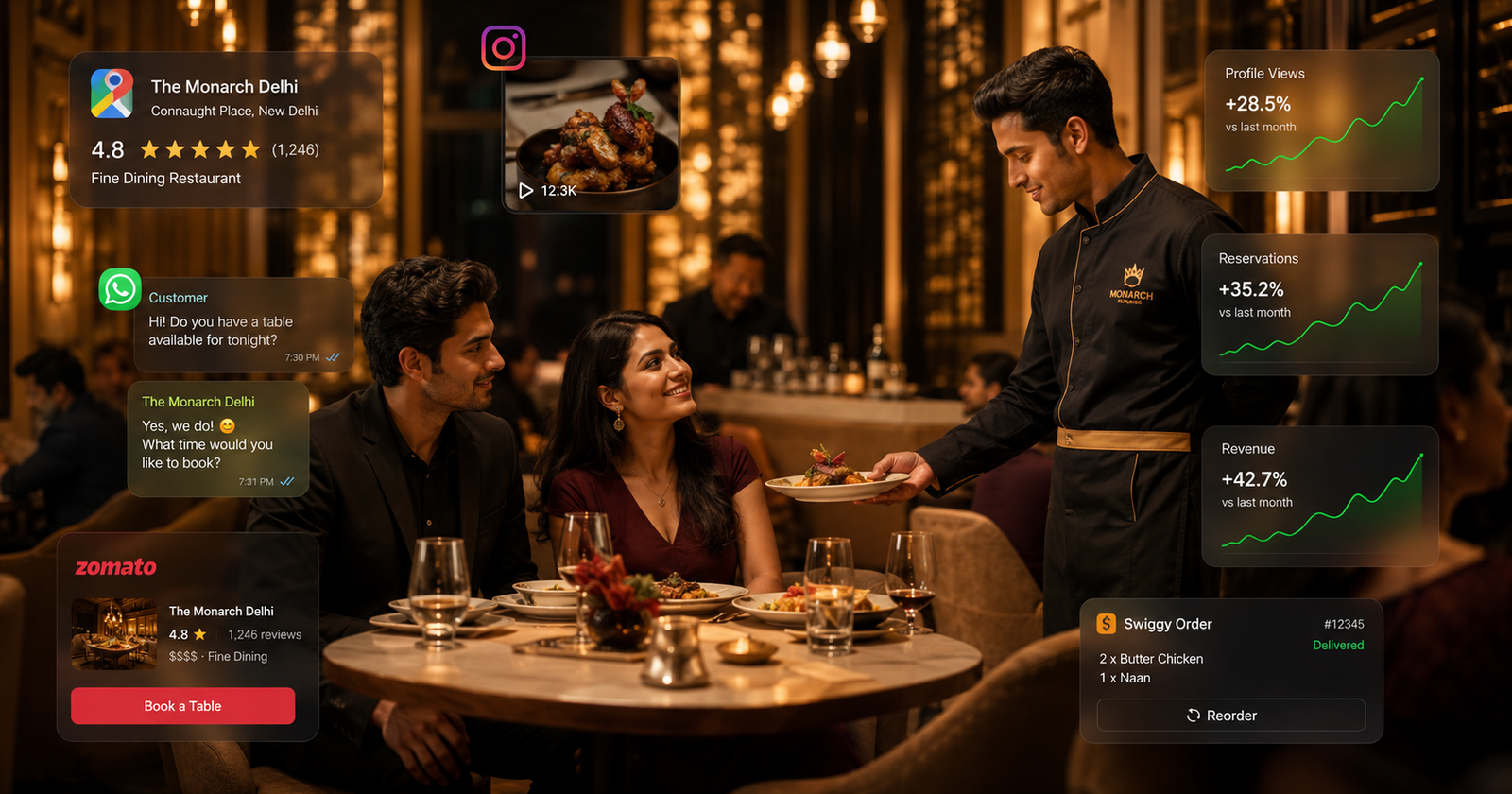
India's restaurant industry crossed the $85 billion mark in 2025. It is growing at 15% annually. Urban Indians now dine out an average of five times a month, and that number is expected to rise to seven or eight times by 2030, driven almost entirely by Gen Z.
The not-so-good news? Most restaurant owners are still marketing the way they did in 2018. Static Facebook posts. A Zomato listing with three blurry photos. An Instagram page that posts once a week and calls it a strategy.
Meanwhile, 90% of guests research a restaurant online before ever walking through the door.
This gap between how customers discover restaurants and how restaurants present themselves online is the single biggest opportunity in the food business right now. At Safal Media, we work with restaurants across the Delhi-NCR region, and show restaurants how the right digital strategy can turn a struggling outlet into a fully booked, high-revenue brand.
This blog covers 30 restaurant marketing ideas built specifically for the Indian market.
Before we get to the tactics, a quick reality check on the numbers:
The data tells a clear story: the battleground for restaurant customers has moved online. The restaurants that win are the ones that show up consistently, look credible, and give people a compelling reason to choose them over the competition.
Here is how to do exactly that.
Before a diner ever arrives at your door, they search for you. Or someone like you. Local SEO is how you make sure they find you, not your competitor two streets over.
1. Claim and Fully Optimise Your Google Business Profile
Your Google Business Profile (GBP) is the most powerful free marketing tool available to any restaurant in India. When someone searches "restaurants near me" or "best butter chicken in Gurgaon," Google pulls from GBP listings to populate the map pack, those three prominent results that appear before any website links.
Most restaurants claim their profile and stop there. Do not do that.
A fully optimised GBP means:
Restaurants that optimise their GBP properly get 2.3 times more reviews than those that do not, and interactions increase by at least 15% within six months of consistent optimisation.
2. Build a Hyper-Local Keyword Strategy Around Your Neighbourhood
Most restaurants target keywords like "best restaurant in Gurgaon." That is fine, but it is also the most competitive category you could pick. A smarter approach is to go hyper-local.
Target search phrases like:
These neighbourhood-level keywords are far less competitive and convert at a much higher rate because the intent is immediate. Someone searching "dinner near Golf Course Road" is deciding right now. Weave these phrases into your website's homepage, your GBP description, your blog posts, and your alt text for images.
3. Use Review Responses as a Silent SEO Tool
Every time you respond to a Google or Zomato review, you have an opportunity to embed relevant keywords naturally.
Instead of just replying "Thank you, we're glad you enjoyed it," try: "Thank you so much for visiting us at [ Your Restaurant Name] in Cyber City, Gurgaon! We're so glad you enjoyed our signature dal makhani and the live music on Saturday evening."
That response contains your location, your cuisine, a specific dish, and a feature, all terms that Google indexes. Do this consistently, and your review responses become a quiet but powerful SEO engine.
4. Own Your Listings on Zomato, Swiggy, and Dineout
These three platforms are where the majority of Indian diners discover new restaurants. With Zomato crossing 80 million monthly active users in 2025, your listing on these platforms is not just a delivery tool; it is a discovery engine.
Treat each listing as a mini-website:
5. Create a Food Blog on Your Restaurant's Website
A blog might seem like extra work. It is, and it pays off considerably.
Every blog post you publish targets a new set of search queries. A restaurant in Gurgaon that writes about "the history of Awadhi cuisine", "how to pair wine with Indian food", or "top things to do in Cyber Hub this weekend" is building topical authority that slowly but steadily pushes its website up in Google rankings.
One good blog post per fortnight is enough to build meaningful traction over six to twelve months.
Social media is no longer about likes. It is about discovery. Instagram is now a search engine for food. If your restaurant lacks a strong presence, you are invisible to a generation of diners who decide where to eat based on what they see on their phones.
6. Use Instagram Reels to Show Your Kitchen Culture
Food photos still work. But Reels consistently outperform static posts in organic reach. The algorithm favours short-form video, and food content on Reels has a natural advantage; it is inherently visual, emotional, and shareable.
The key shift: do not just show the dish. Show the making of the dish.
Behind-the-scenes content humanises your brand, builds trust, and earns shares from viewers who tag friends with "we need to go here."
Post timing matters too. Share lunch content between 11 AM and 1 PM when people are planning their afternoon. Post-dinner content between 4 PM and 6 PM, when evening plans are forming.
7. Collaborate with Local Micro-Influencers
Micro-influencers, creators with between 10,000 and 50,000 followers, consistently outperform celebrity accounts for restaurant marketing in India. Their audiences are niche, local, and highly engaged. A food blogger with 25,000 followers in Gurgaon will drive more actual walk-ins than a national food page with a million followers spread across the country.
Search local food hashtags like #GurgaonFoodBlogger or #DelhiFoodReview on Instagram to find creators who already post about restaurants in your area.
What to ask them for: a Reel from their visit, three to five Instagram stories with your location tagged, and a mention in their highlights. That is your most cost-effective paid media.
8. Run 'Tag a Friend' Giveaway Campaigns
This is one of the simplest and most effective tactics for restaurants on a tight marketing budget.
The format is straightforward: post an appetising image of your most photogenic dish or announce a limited-time offer, and ask followers to tag a friend they would bring to try it. The winner gets a complimentary meal or discount.
Every tag is a new person introduced to your brand at zero additional cost. These campaigns work especially well for new menu launches, seasonal specials, or milestone celebrations.
9. Build a WhatsApp Business Channel for Direct Customer Engagement
WhatsApp is where India communicates. With over 500 million users in India and open rates between 85% and 95%, it is the most efficient direct marketing channel available to restaurants, and most owners are not using it deliberately.
Here is how to build a WhatsApp customer list that actually converts:
Once your list is built, use it for weekly specials, new menu drops, reservation confirmations, and flash offers. Keep it conversational, not corporate.
10. Create a Recurring Content Series
Consistency on social media beats brilliance. Rather than scrambling for content ideas each week, build a recurring series that gives your audience a reason to return to your profile.
Ideas that work well for Indian restaurants:
The most memorable restaurants are not just places that serve food. They are venues that create experiences. Event-based marketing builds this reputation while simultaneously generating PR, social content, and walk-in traffic.
11. Host a Regional Heritage Night
India's culinary diversity is extraordinary, and vastly underexplored by most restaurants. A Heritage Night series that celebrates different regional cuisines is one of the most compelling and naturally shareable event formats a restaurant can run.
Consider themed evenings around Awadhi cuisine from Lucknow, Chettinad from Tamil Nadu, or a Bengali festive menu, and you can turn it into an event by attaching a story.
This kind of event earns earned media from food bloggers, generates organic social content from guests, and positions your restaurant as a cultural institution rather than just a place to eat.
12. Partner with RWAs (Resident Welfare Associations)
This is one of the most underutilised marketing channels available to restaurants in Delhi-NCR, and it is almost entirely offline.
Gurgaon's major residential townships, DLF Phases, Unitech enclaves, Sohna Road complexes, all have active RWAs that organise regular events: festive celebrations, weekend markets, health and wellness fairs, cultural programmes. These events gather hundreds or thousands of residents from the same neighbourhood.
13. Sponsor Local College Fests and Corporate Office Events
Gurgaon's concentration of multinational corporations and educational institutions creates a specific opportunity. A single well-executed presence at a corporate office event, whether a food stall, branded catering, or a sponsored lunch, puts you in front of decision-makers who regularly book tables for team dinners, client lunches, and off-sites.
Budget a few thousand rupees for a well-targeted sponsorship and track how many new customers mention they heard about you through the event. The conversion rate from these touchpoints tends to be higher than most paid digital channels.
14. Host Networking Dinners for Business Communities
Gurgaon is home to a dense ecosystem of startup founders, corporate professionals, and independent business owners who are constantly looking for well-designed venues to meet. A monthly networking dinner, co-hosted with a LinkedIn community group, a chamber of commerce chapter, or a startup accelerator, provides your restaurant with a recurring revenue stream while building its reputation as a premium meeting space.
15. Create a Private Dining Package for Milestone Occasions
Rather than managing each enquiry for birthday dinners, anniversaries, and corporate gatherings individually, build a clearly defined Private Dining Package.
A strong package includes: a reserved section or private room, a set menu (or limited customisation), a décor setup, and optionally a photography arrangement. Offering this as a flat-price bundle removes the friction of negotiation and makes it easy for customers to book.
Promote it on your website, on your Zomato and Dineout profiles, and through targeted Instagram ads. This single offering can meaningfully increase your average revenue per booking.
Organic marketing builds your foundation. Paid marketing accelerates it. In India's competitive restaurant landscape, well-targeted digital advertising is one of the fastest ways to bring new customers through your door.
16. Run Hyperlocal Meta Ads Targeting a 5-Kilometre Radius
Facebook and Instagram's location targeting allows you to show ads exclusively to people within a specific radius of your restaurant. For most restaurants, a 5 km radius is the sweet spot, close enough to convert, wide enough to reach.
A strong hyperlocal ad for a restaurant includes:
Run these ads Thursday through Saturday when dining intent is highest. Set a budget based on your margins, and monitor cost per click closely.
17. Use Google Ads for High-Intent Search Traffic
Someone searching "best North Indian restaurant near me" on Google is ready to make a decision. Google Search Ads place your restaurant at the top of search results before organic listings, and for local restaurant searches, the cost per click is relatively affordable in most Indian cities.
Use call extensions, location extensions, and ad copy that speaks to urgency: "Book a table today" or "Open for lunch and dinner."
18. Retarget Website Visitors and Instagram Engagers
Most people who visit your website or engage with your Instagram posts do not convert on the first interaction. Retargeting ads follow these warm audiences as they browse online and show them a specific offer to bring them back.
19. Explore Zomato and Swiggy In-App Ad Placements
Both platforms offer paid promotional placements that push your restaurant to the top of discovery feeds when users are actively searching for food. These are arguably the highest-intent ad placements available to a restaurant; the user is already on the app, already hungry, already deciding.
Test a campaign during peak hours (12–2 PM and 7–10 PM) and track the impact on orders over a two-week period before scaling spend.
20. Invest in Short-Form Video Ads
Static display advertising is losing ground to video. Short video ads of 15–30 seconds that show the sizzle of a dish being plated, the energy of a busy weekend evening, or the warmth of your space outperform image-based ads with significantly higher click-through rates.
It costs five to seven times more to acquire a new customer than to retain an existing one. Yet most restaurants spend the bulk of their marketing budget chasing new faces while neglecting the people who already love them. These strategies fix that.
21. Build a WhatsApp-Based Loyalty Programme
App-based loyalty programmes have notoriously low adoption rates in India outside of the large QSR chains. The friction of downloading another app is simply too high. WhatsApp removes that friction entirely.
A simple loyalty programme delivered through WhatsApp Business works like this: a customer opts in, receives a digital stamp for each visit (tracked via a simple Google Sheet or a basic CRM), and redeems a reward at their fifth or tenth visit. No app required. No card to carry. Just a conversation they already have on their phone.
Indian restaurants that implement WhatsApp marketing typically see a return on their spend of 3 to 5 times. Top performers report up to eight to ten times ROI.
22. Launch a Regulars' Club
Create a curated inner circle of your most loyal customers and make them feel genuinely special.
This kind of exclusive communication costs almost nothing. The goodwill it generates and the word-of-mouth it produces are disproportionate to the effort.
23. Use Post-Dining Follow-Ups with a Return Incentive
Send a thank-you message within 24 hours of a customer's visit. Keep it short, personal, and end with a reason to return.
This single touchpoint, sent consistently, can increase return visit rates by 12–17% over time. It also creates an opportunity for customers to share feedback directly with you before they publicly post a negative review.
24. Create a Corporate Meal Plan Partnership
Gurgaon's density of office parks and tech campuses creates a uniquely valuable opportunity: bulk meal deals with nearby offices.
Approach HR managers or office managers at companies within a one-kilometre radius and offer a Corporate Meal Plan, a fixed-price lunch or dinner package for their employees, available on weekdays. This provides your restaurant with predictable weekday revenue, which is often the weakest period, and converts dozens of office workers into regular individual customers who eventually bring their families and friends on weekends.
Digital marketing earns reach. Offline marketing earns trust. The restaurants that win in the long term combine both with intention.
25. Get Listed in Delhi-NCR Food Guides and Local Blogs
Platforms like Little Black Book (LBB), Curly Tales, Delhi Food Walks, and Zomato's editorial collections reach enormous audiences of food-curious urban consumers. A feature on LBB, in particular, drives both web traffic and actual walk-ins from readers who treat these guides as trusted recommendations.
Getting featured is often free; it requires a well-crafted pitch to the editorial team, a compelling story about your restaurant, and strong photography.
26. Partner with Gurgaon Hotels and Serviced Apartments
Hotel concierges are asked "Where should I eat?" dozens of times a day. They refer guests to restaurants they trust, have visited, and know will make their guests happy.
Visit the concierge teams at nearby hotels, particularly business hotels with transient corporate guests, and introduce yourself. Leave printed menus, QR-coded table cards, and a personal mobile number for reservations.
This channel costs almost nothing and generates a steady stream of high-value guests who are often expensing their meals.
27. Participate in Gurgaon's Food Festivals and Weekend Markets
Gurgaon hosts multiple food festivals and weekend markets throughout the year. These events draw thousands of food enthusiasts in discovery mode.
A stall at a well-attended food festival does more than generate direct revenue. It introduces your brand to hundreds of new potential customers, generates social media content, and gives you an opportunity to collect WhatsApp opt-ins from people who genuinely love your food.
28. Build a PR Story Around Your Origin, Chef, or Sourcing
Journalists and food writers are always looking for stories. Not just good food, but stories. A restaurant that sources all its dairy from a single farm in Haryana. A founder who left a corporate career to open the restaurant their grandmother dreamed of running.
These narratives earn coverage in well-known publications. A well-pitched founder story is worth more in credibility than most paid media.
Marketing without measurement is just spending. Every tactic in this guide should be tracked so you know what is working, what is not, and where to double down.
29. Build a Simple Monthly Marketing Dashboard
You do not need an enterprise analytics stack. You need four numbers reviewed at the start of every month:
These four metrics tell you most of what you need to know about whether your marketing is working. Anything beyond this is useful context, but these are the numbers that should drive decisions.
30. When to Hire a Digital Marketing Agency for Your Restaurant
There is a point at which managing your restaurant's digital presence becomes a second full-time job. That is the moment to consider working with a specialist agency.
If you find yourself consistently not posting, not responding to reviews, not tracking what is working, or feeling like your competitors are consistently outpacing you online, it is time to bring in help.
At Safal Media, we work with restaurants across Gurgaon and Delhi-NCR to build and execute digital marketing strategies that translate directly into bookings, orders, and revenue. If you want to see what that looks like in practice, we would love to talk.
To get your restaurant noticed on Google, start with on-page SEO by creating dedicated pages for your specific cuisines, neighbourhoods, and dining occasions, ensuring each has unique meta tags.
Don't let slow load times turn diners away; focus on technical SEO by running a Google PageSpeed test and keeping your mobile score above 70. You can build online credibility through link building by securing features on local food blogs and media sites.
Finally, don't forget AI search optimisation, adding clear FAQ sections and structured data helps AI tools easily pull and recommend your restaurant to hungry searchers.
Email is a goldmine for pulling in repeat guests if you approach it the right way. Start building your list organically through website booking forms, payment opt-ins, and tempting social media sign-up perks.
Keep your frequency and content balanced by sending just two emails a month: one newsletter featuring chef updates or new dishes, and one highly targeted special offer. The real secret sauce here is personalisation.
Simply addressing your guests by name and mentioning how long it's been since their last visit will convert casual readers into packed tables much faster than a generic blast.
Safal Media is a digital marketing agency based in Gurgaon, working with restaurants, cafes, and food businesses across Delhi-NCR to build online presence that translates into real revenue.
We handle local SEO, Instagram and WhatsApp management, Google and Meta advertising, Zomato and Swiggy listing optimisation, and content creation, all in one integrated strategy built specifically for your restaurant and your market.
If you are ready to stop guessing at marketing and start building something that works, get in touch with our team today.