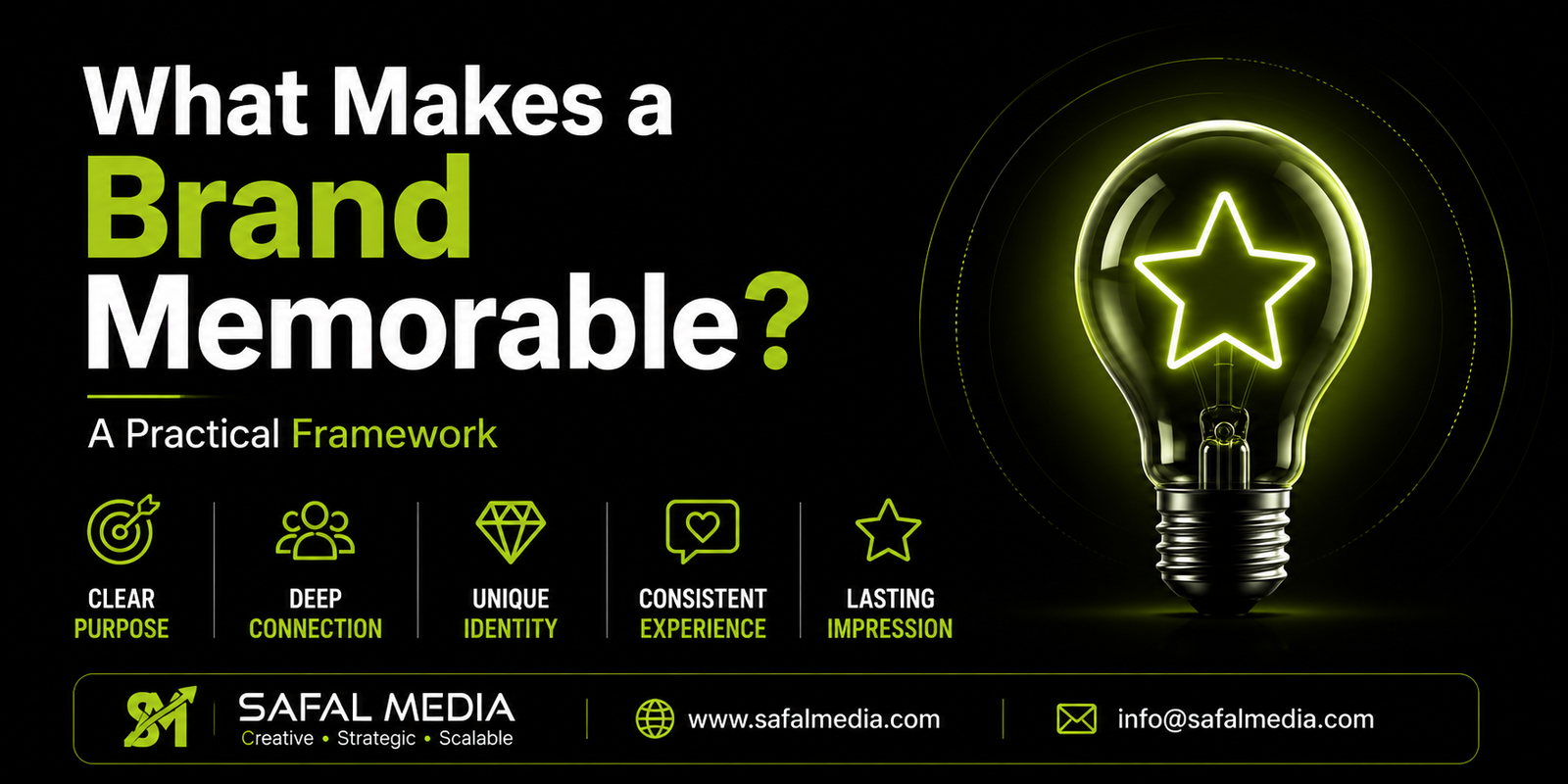
A memorable brand isn't built on a good logo alone. It's the product of five things working together: a distinct visual identity, clear strategic positioning, consistent messaging, cross-channel execution, and disciplined follow-through. Brands that skip straight to design, without positioning or a documented voice, tend to look professional but get forgotten.
Ask most business owners what makes a brand memorable, and the answer usually starts and ends with the logo. It's an understandable instinct, the logo is the most visible piece of a brand, but it's also why so many companies invest in a redesign and see no real shift in how customers perceive them. A logo is one output of branding, not the strategy itself.
A memorable brand is a system: a set of decisions about how a business looks, sounds, and shows up, applied consistently enough that people recognise it without having to think. This post breaks that system into five practical elements, shows how to tell if your current brand is missing any of them, and outlines how a structured branding process turns the framework into something your team can actually use.
Why Do Some Brands Stick While Others Get Forgotten?
Memorability isn't really about being liked. It's about being recognised instantly, recalled accurately, and trusted enough to choose over an alternative. Those are three separate outcomes, and a brand can fail at any one of them even while succeeding at the others.
A business can have a striking logo (recognition) but confusing messaging that makes it hard to recall what they actually do. Or consistent messaging on the website but a completely different tone on social media, which erodes trust the moment a prospect compares the two. A brand identity that works is the totality of how customers perceive a business — the visual system, the communication style, and the promise behind both, held together consistently across every place a customer encounters the business.
That's the frame the rest of this post works from: not "how do we make a better logo," but "how do we make every touchpoint reinforce the same impression."
The 5 Elements of a Memorable Brand
1. A Distinct Visual Identity
Visual identity is the complete system of graphic elements that represent a business — logo, colour palette, typography, and the supporting design assets built around them. The distinction that matters here is custom versus templated. A logo built from a stock icon and a default font pairing might look fine in isolation, but it won't hold up once it's placed next to five competitors doing the same thing. A custom, vector-based identity — built to scale from a business card to a billboard without losing clarity — is what actually creates recognition over time.
2. Clear Brand Positioning
Positioning defines where a business sits in the market relative to competitors: who it's for, what it offers them, and why they should choose it over the alternative down the road. In a commercial environment as dense as Gurgaon's — Cyber City, Udyog Vihar, the Sector 44 corridor — this is often what separates businesses that grow through referral and reputation from those stuck competing purely on price. Positioning work typically includes competitor mapping, audience persona development, and a defined Unique Value Proposition (UVP) that the rest of the brand gets built around.
3. Consistent Brand Voice and Messaging
Messaging is what a business says and how it says it — tone of voice, key messages, and language guidelines that stay consistent across a website, a LinkedIn page, and a client proposal. This is the element businesses skip most often. It's common to see a company invest heavily in visual identity and end up with something that looks professional but reads inconsistently — formal on the website, casual on Instagram, generic in the proposal deck. Visual polish without a defined voice produces a brand that looks put-together but doesn't sound like anyone in particular.
4. Cross-Channel Consistency (Digital Branding)
Digital branding ensures a business communicates the same way across every online touchpoint — website, social profiles, email, and paid advertising. Inconsistent digital branding is one of the most common reasons businesses lose credibility with prospects who research a company online before ever making contact. If the Instagram grid, the website, and the email signature all look like they belong to three different companies, that inconsistency reads as a red flag before a single conversation happens.
5. Professional Collateral and Touchpoints
For B2B businesses in particular — especially those operating out of corporate parks and business hubs — the physical and digital materials used in meetings, pitches, and exhibitions are a direct signal of credibility. A branded presentation deck, a well-designed company profile, and consistent print collateral do quiet work in the background of every client interaction.
How Do You Know If Your Brand Needs a Refresh?
A quick self-audit. If more than two or three of these are true, the brand likely has a consistency problem rather than a strategy problem — or, in some cases, both:
• The logo appears in different colour variations across the website, social media, and print materials
• There's no documented style guide — colours, fonts, and usage rules exist only in someone's memory
• Messaging tone shifts noticeably between the website, social channels, and sales conversations
• Competitors in the same space are visually indistinguishable at a glance
• The brand hasn't been reviewed since the business's positioning, audience, or offering changed
The table below is a rough guide to which fix actually applies:
|
Situation
|
Logo-Only Fix
|
Full Brand Identity
|
|
Logo looks dated but positioning and messaging still work
|
Usually sufficient
|
Not required
|
|
Business has pivoted audience, offering, or market
|
Won't solve it
|
Recommended
|
|
Visuals are fine but messaging is inconsistent
|
Won't solve it
|
Recommended (messaging-led)
|
|
Starting a new business from scratch
|
Not applicable
|
Recommended
|
How Safal Media Builds Memorable Brands
The framework above is only useful if it's applied in a structured way. At Safal Media, a branding agency in Gurgaon with 7 years of experience and 500+ design projects delivered across Delhi NCR, every brand project follows the same four-stage process:
• Brand Discovery Workshop — a structured 90-minute session covering business goals, target audience, competitive environment, and existing brand perceptions, producing a written Discovery Brief.
• Creative Strategy & Concept Development — 2–3 distinct creative directions, each presented as a mood board with rationale, so direction is agreed before any detailed design work begins.
• Design Development & Review — full visual identity assets developed across two structured revision rounds, keeping the project on a defined timeline.
• Final Delivery & Brand Launch — all source files, a comprehensive Brand Style Guide (15–25 pages), and a 30-minute handover call.
The principle underneath all four stages is strategy before design — no visual decision gets made until the business goals and positioning are documented. Clients who complete a full rebrand see a 3x average improvement in brand engagement (social interactions, email open rates, time-on-site), and every project closes with full ownership: source files in AI, EPS, SVG, and PDF, with no licence fees or dependency on the agency for future updates.
For a closer look at what's included across visual identity, digital branding, positioning, messaging, and corporate collateral, see Safal Media's Branding Services page.
Conclusion
Memorability was never really about the logo. It's the outcome of five decisions made together — a distinct visual identity, clear positioning, a consistent voice, disciplined execution across channels, and collateral that backs it all up in person. Skip any one of them, and a brand can still look polished while failing to actually stick in someone's mind.
The businesses that get remembered aren't the ones with the most creative logo. They're the ones where every touchpoint, website, social feed, pitch deck, sales call, says the same thing, in the same voice, consistently enough that recognition happens without effort. That's what a documented brand system is built to protect: not a single good design, but the discipline to apply it everywhere, every time.
If your brand currently depends on people remembering the logo rather than the impression, that's usually the first sign it's time to look at the system behind it, not just the artwork.
Ready to Build a Brand That Sticks?
A memorable brand isn't the result of a single good design decision — it's what happens when visual identity, positioning, voice, and execution are all built to reinforce each other. Get a free quote from Safal Media's Gurgaon branding team to start with a Discovery Workshop.