Between four and six. Name, phone number, city, property type and a budget range are usually enough. You can collect everything else during the consultation call.

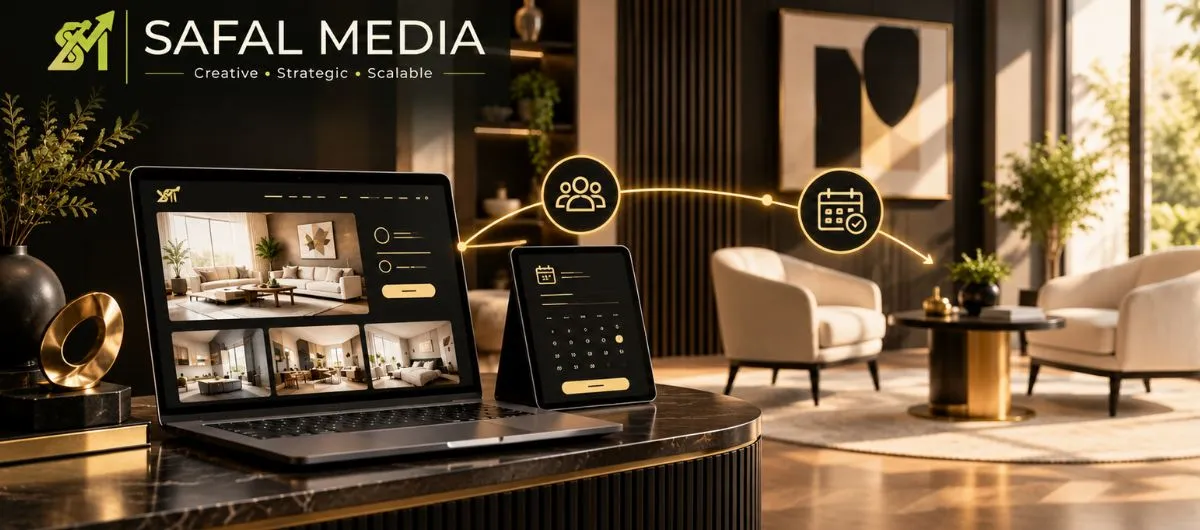
Most interior design websites look beautiful and still generate almost no enquiries. Visitors scroll through the gallery, admire a living room, and leave without ever contacting the studio. The problem is rarely the design work. It is how the website guides a visitor from "this is lovely" to "I want to book a consultation."
At Safal Media, we look at interior design websites the way a homeowner does: as a decision-making tool, not just a portfolio. Here is how to build one that converts.
An interior design website turns visitors into consultation leads by showing proof fast, guiding them to one clear next step, and removing friction. Use a project-led homepage, a short booking form, WhatsApp and call options, budget-aware messaging, local SEO pages, and quick follow-up within an hour.
Lead conversion is the process of turning anonymous website visitors into people who share their contact details and ask for a consultation. For an interior designer, a "lead" is not a newsletter subscriber or a Pinterest-style browser. It is someone who has a home or office, a rough budget, and a reason to talk now.
The common problem is a gap between attention and action. Typical symptoms include:
Fixing this is a mix of design, copy, technical setup and follow-up process, not just a redesign.
This approach suits:
If your studio gets fewer than 10 to 15 genuine enquiries a month from your website, or a large share of your enquiries are "just checking prices," this applies to you.
Step 1: Make the homepage answer three questions in five seconds
A visitor should immediately know what you design, where you work and what to do next. A strong first screen has a clear headline ("Turnkey home interiors in Gurgaon, delivered in 90 days"), one hero project image and one primary button such as "Book a Free Design Consultation."
Step 2: Organise your portfolio as case studies, not a photo dump
Instead of 200 untitled photos, show 8 to 12 projects with:
This lets visitors picture their own home and budget in your work, which is what triggers a booking.
Step 3: Add trust signals near every call to action
Place client testimonials, Google review ratings, years of experience, number of homes delivered and warranty terms next to your buttons, not buried on an "About" page. People hesitate to spend lakhs on interiors, so reassurance has to sit at the moment of decision.
Step 4: Simplify the consultation form
Ask for only what you need to qualify and call back:
Every extra field lowers the completion rate. Details like exact floor plans can be collected on the first call.
Step 5: Offer more than one way to reach you
Not everyone wants to fill in a form. Add a sticky WhatsApp button, a click-to-call button on mobile, and an optional "Get a rough estimate" calculator. Most interior design visitors browse on their phones, so mobile responsiveness is essential. A website design company in Gurgaon that builds mobile-first layouts can make this seamless.
Step 6: Be transparent about pricing
You do not need to publish a full rate card, but showing indicative ranges (for example, "Full-home interiors typically start from ₹1,200 per sq ft") filters out mismatched enquiries and builds trust with serious ones. A "How our pricing works" page often becomes one of the best-converting pages on the site.
Step 7: Build local search visibility
Homeowners search with phrases like "interior designer in Gurgaon" or "interior designers near me." Create dedicated pages for each city and service, keep your Google Business Profile updated with fresh project photos, and collect reviews steadily. Local SEO services in Gurgaon and SEO services in Delhi can help studios capture this high-intent traffic instead of relying only on paid ads.
Step 8: Use social media to warm up leads
Reels of project walkthroughs, site progress updates and design tips keep your studio visible before a homeowner is ready to enquire. A social media agency in Gurgaon or a social media marketing agency in Gurgaon can plan content that drives people back to your consultation page rather than just collecting likes.
Step 9: Follow up within an hour
The fastest studio often wins the project. Set up instant email or WhatsApp confirmations, alert your team when a form is submitted, and aim to call back within 60 minutes during business hours. A short reply such as "Thanks, Priya. We'll call you at 6 PM as requested. Here are three recent 3BHK projects" beats a generic auto-reply.
Step 10: Measure and improve every month
Track form submissions, calls, WhatsApp clicks, cost per lead, lead-to-consultation rate and consultation-to-project rate. Small tests, such as changing a button label or moving testimonials higher, often lift conversions over a few months.
Costs vary with your starting point and market. The ranges below are indicative for Indian studios and are not fixed quotes.
|
Component |
Indicative Cost (INR) |
Typical Timeline |
What to Expect |
|
Conversion-focused website (new or redesign) |
₹40,000 – ₹2,00,000+ |
3–6 weeks |
Better first impression, lead forms, portfolio case studies |
|
Conversion tweaks on an existing site |
₹10,000 – ₹40,000 |
1–2 weeks |
Quicker gains from clearer CTAs and simpler forms |
|
Local SEO and content |
₹15,000 – ₹50,000/month |
3–6 months to build momentum |
More organic visibility for local searches |
|
Social media management |
₹15,000 – ₹40,000/month |
2–4 months |
Stronger brand recall and warmer enquiries |
|
Paid ads (spend, excluding agency fee) |
₹30,000 – ₹1,00,000+/month |
Leads can start in 1–2 weeks |
Faster enquiries, needs landing page optimisation |
Studios that fix their conversion basics often see form submissions rise within 4 to 8 weeks. SEO-driven leads take longer, usually 3 to 6 months, but tend to cost less over time. No agency can guarantee a specific number of leads, so treat any such promise with caution.
|
Approach |
Speed |
Cost per Lead |
Lead Quality |
Best For |
|
Conversion-optimised website |
Medium |
Low over time |
High |
Every studio (foundation) |
|
Local SEO |
Slow (3–6 months) |
Low over time |
High intent |
Studios wanting steady, long-term leads |
|
Google Ads |
Fast |
Medium–High |
High intent |
Studios needing quick enquiries |
|
Social media marketing |
Medium |
Medium |
Mixed, builds trust |
Brand-building and remarketing |
|
Portals and directories |
Fast |
Medium |
Mixed, shared leads |
Studios starting from zero |
|
Referrals |
Slow, unpredictable |
Very low |
Very high |
Established studios (but hard to scale) |
The strongest results usually come from combining a conversion-ready website with local SEO and one paid or social channel.
If your interior design website is getting views but not enough enquiries, Safal Media can help. As a digital marketing company in India, we design conversion-focused websites, build local SEO strategies and plan social media campaigns for interior design studios in Gurgaon, Delhi NCR and Qatar.
Get a free website and lead-conversion audit from Safal Media. Visi safalmedia.com and tell us about your studio. We will show you exactly where you are losing potential clients and how to win them back.
An interior design website wins clients by making the next step obvious, the proof visible and the response fast. Present projects as case studies, keep the consultation form short, add WhatsApp and call options, and follow up within an hour. Then build long-term visibility with local SEO services in Gurgaon or SEO services in Delhi.
Ready to turn more visitors into consultations? Book a free audit with Safal Media at safalmedia.com.