A citation includes a clickable link back to your website inside the AI's answer. A mention only references your brand name, with no link — useful for reputation tracking, but it won't drive referral traffic the way a citation does.

Your website can sit at position one on Google and still be invisible to ChatGPT.
That sentence would have sounded like a contradiction two years ago. In 2026, it's just how search works. Google's own ranking position no longer predicts whether an AI engine will cite you, pages ranked 11 to 100 now account for roughly a third of all AI Overview citations, and pages ranked beyond 100 account for another third. Position one still carries the highest single citation probability, but it has dropped sharply compared to a year ago, while lower-ranked and even unranked pages are picking up the difference.
The old scoreboard, rank, impressions, click-through rate was built for a search engine that handed you a list of blue links. It wasn't built for a search engine that reads your content, decides what's true, and writes the answer itself.
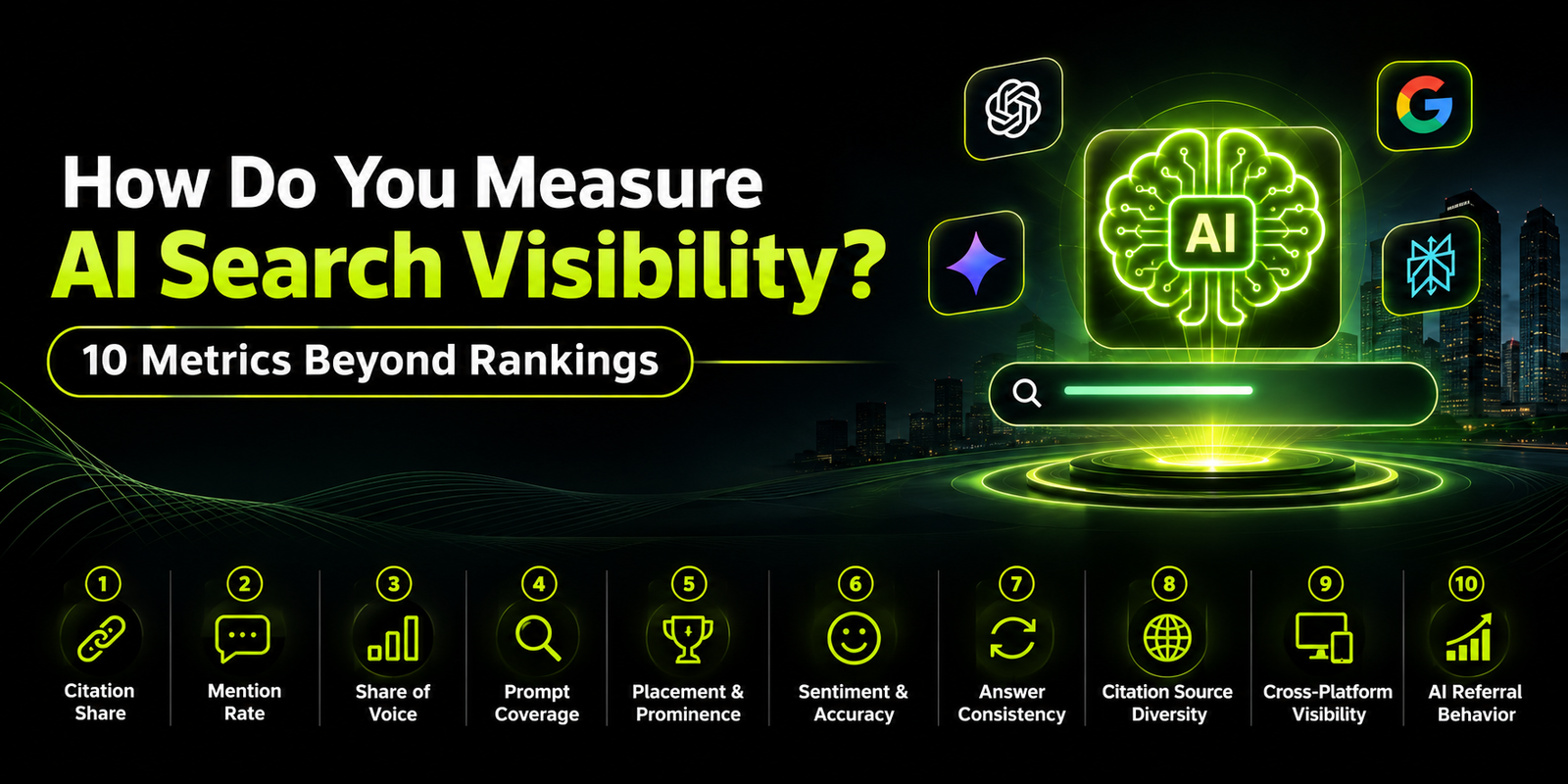
That's the shift AI search visibility measures: not where you rank, but whether you're the source an AI system trusts enough to repeat. This post walks through the 10 metrics that actually track that — and three familiar numbers worth retiring from your reporting deck.
Two things happened at once. First, the link between Google rank and AI citation broke — barely a third of AI Overview citations now trace back to a top-10 organic result, down sharply from the year before. Second, the destination changed: the overwhelming majority of AI search sessions now end without a single click to a website. Visibility no longer means "shows up before the click." It means "shows up inside the answer, whether or not the click happens."
|
Traditional SEO Metric |
What It Measured |
Its AI Search Equivalent |
|
Keyword ranking position |
Where you appear on a results page |
Citation share, placement & prominence |
|
Click-through rate |
How many people clicked your listed link |
AI referral behavior, downstream conversion |
|
Backlink count |
Authority signals to a crawler |
Entity authority, citation source diversity |
|
Impressions |
How often you were shown |
Prompt/query coverage, share of voice |
This is why generative engine optimization (GEO) — the practice of making content citable inside AI-generated answers — has become the layer sitting on top of, not replacing, traditional SEO. At Safal Media, our AI SEO and GEO work treats these as one connected system: rank still matters for discovery, but citation is what determines whether that discovery survives contact with an AI answer engine.
Citation share is the percentage of your tracked prompts where an AI engine links directly to a URL you own — not just says your name, but cites your page as the source. This is the single most important number in AI search visibility tracking, because a citation carries a clickable link back to your site; a mention doesn't. If you're only measuring "does the AI know who I am," you're missing the metric that actually drives referral traffic and trust.
How to check it: Run a fixed set of category prompts across ChatGPT, Perplexity, and Google AI Overviews weekly, and log which responses include a link to your domain versus a competitor's or a third-party aggregator's.
Mention rate tracks how often your brand name shows up in an AI answer without a link attached — often sourced from Reddit threads, review sites, or comparison articles you don't control. Because most AI mentions originate from third-party sources rather than your own content, mention rate reveals how far your reputation travels on its own. Brands that earn both a citation and a mention are meaningfully more likely to stay visible across repeated prompt runs than brands that only earn one or the other.
Why it matters more than people think: a high mention rate with a low citation share tells you the AI trusts your category expertise but doesn't trust your website enough to link it — a content and structured-data gap, not a brand-awareness gap.
Share of voice is your citation-and-mention frequency measured against named competitors across the same prompt set, tracked over time rather than in a single snapshot. If your brand appears in 15 out of 100 relevant AI answers in your category, that's a 15% share — a number worth watching month over month, the same way you'd watch organic market share, except the "market" here is a set of AI conversations, not a results page.
Keyword volume told you how many people searched a term. Prompt coverage tells you what percentage of the actual questions your buyers ask an AI assistant — in full, conversational form — surface your brand at all. This is a genuinely different unit of measurement than a keyword list, and building it requires collecting real buyer-intent questions, not head terms.
Being cited is not the same as being cited first. Placement measures whether you're the AI's lead recommendation or a footnote buried in bullet seven. In a zero-click environment, prominence functions the way a top-three organic ranking used to — it's the difference between being the answer and being an afterthought inside someone else's answer.
An AI engine can cite you frequently and still describe you badly — outdated pricing, a discontinued feature, a comparison that favors a competitor by default. Sentiment and framing accuracy track how you're described, not just how often. A frequent but negative or inaccurate mention can do more damage than no mention at all, which is why this metric belongs in the same dashboard as citation share, not treated as a separate "reputation" project.
This is the metric most beginner guides skip entirely, and it's arguably the most important one. AI answers are not stable. Only a minority of brands stay visible from one AI answer to the next on an identical prompt, and even fewer hold that visibility across five consecutive runs. That volatility means a single visibility check tells you almost nothing — you have to track drift over repeated runs to know whether your presence is real or a one-off fluke of that specific generation.
Practical takeaway: never report AI visibility off a single prompt run. Run the same prompt set at least weekly and track the variance, not just the average.
Are your citations coming from your own domain, or entirely from third-party directories, review platforms, and forums talking about you? Heavy reliance on third-party citation sources is fragile — you don't control that content, its accuracy, or whether it stays online. Tracking the ratio of owned-domain citations to third-party citations tells you whether your visibility is durable or borrowed.
ChatGPT, Perplexity, Google AI Overviews, Gemini, and Copilot each draw from different data sources and re-rank content differently, and citation behavior can vary enormously from one platform to the next for the exact same query. Checking only one platform — usually Google AI Overviews, because it's the most visible — gives an incomplete and sometimes misleading picture. A real AI search visibility program tracks all major platforms your audience actually uses, not just the easiest one to check.
Not every AI session ends without a click — a meaningful share do convert into visits, and those visits behave differently than typical organic traffic, often converting at a notably higher rate. The catch: most analytics platforms misclassify AI referral traffic as "direct," which quietly erases this signal from your reporting unless you specifically build tracking for it. Fixing this misattribution is one of the highest-leverage, least-glamorous fixes in AI search measurement right now.