Remember when getting your business to the top of Google meant optimising for a neat list of ten blue links? You’d sprinkle in a few keywords, build some backlinks, and wait for the clicks to roll in.
Today, the internet looks completely different.
More and more people are bypassing traditional search engines entirely. Instead, they are asking direct, complicated questions to AI tools like Perplexity, ChatGPT (SearchGPT), and Google AI Overviews.
Instead of sending users to a website, these AI engines browse the web, pull information from different places, and stitch together a single, conversational answer. If a user gets their answer right there on the screen, they don't click a link. In fact, current search data shows that informational searches are increasingly leading to "zero-click" behaviour.
So, how does your business stay visible when AI answers the question before a user ever hits your website? The answer is GEO, or Generative Engine Optimization. It’s the art of formatting your content so AI engines can easily find it, trust it, and choose to cite your brand.
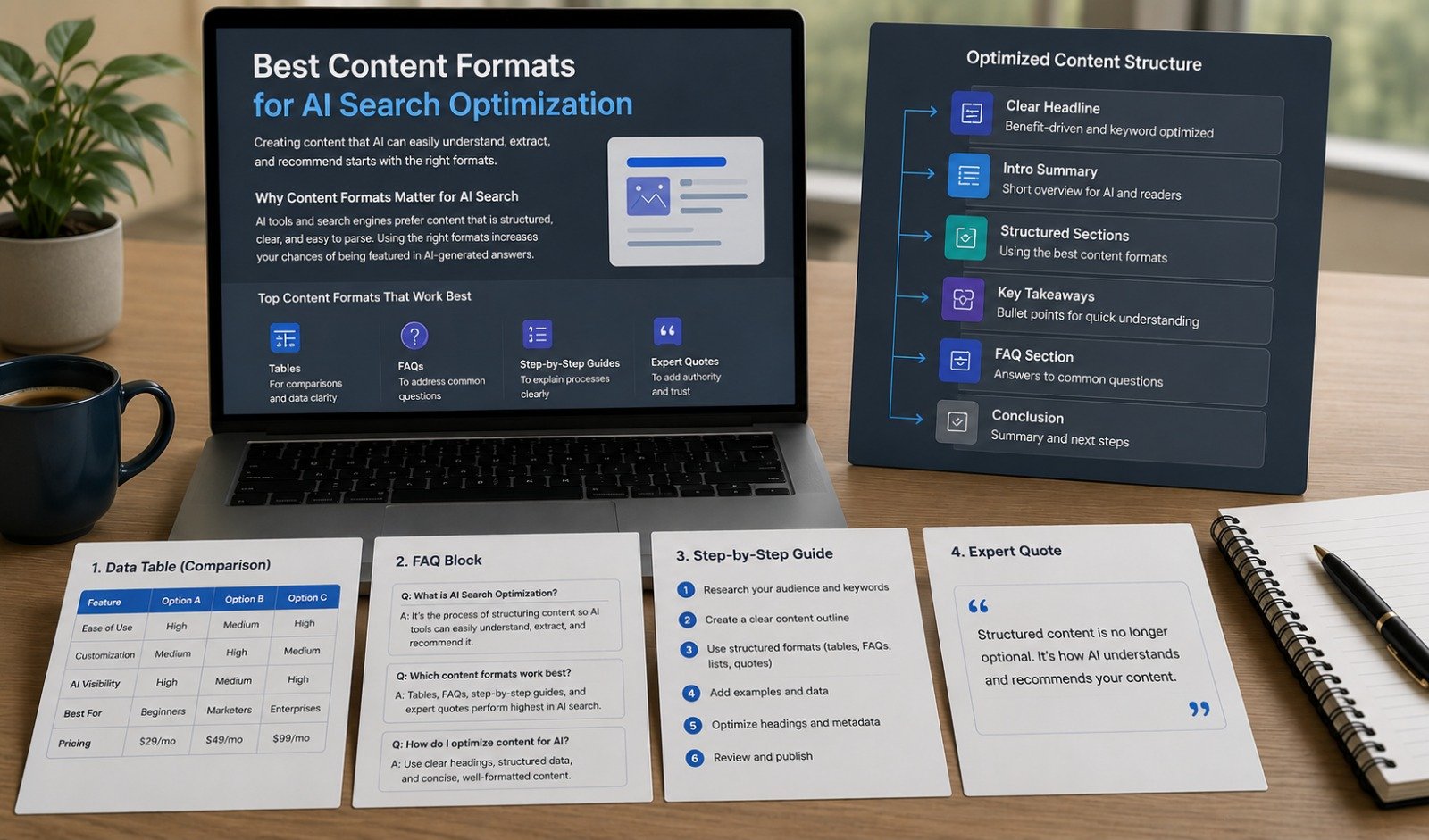
Top Content Formats for AI Search Engine Optimization
Here are the specific content formats that AI engines love to pull from, and exactly how you can use them.
1. How Do Data Tables Help Your Website Rank in AI Search?
AI engines are essentially smart data-sorting assistants. They don't have time to read through paragraphs of emotional marketing fluff (like "We offer the absolute best, most cutting-edge software on the planet"). They want cold, hard facts that they can instantly compare.
A breakthrough study by researchers at Princeton University and Georgia Tech found that simply adding clear statistics and metrics to your content can improve your visibility in AI search results by up to 30%.
When an AI engine tries to answer a query like "Compare the top three project management tools for small teams," it looks for pre-organised data structures.
The Fix: Trade Adjectives for Attributes
Stop using vague words like "incredibly fast" or "highly affordable." Use precise numbers instead. If you are comparing services, don't write it in a long paragraph; put it into a clean, easy-to-read table.
|
Feature / Metric
|
Our Standard Plan
|
Competitor A
|
Competitor B
|
|
Setup Time
|
Under 10 minutes
|
2 to 3 business days
|
24 hours
|
|
Data Processing Latency
|
Sub-3-millisecond
|
12 milliseconds
|
8 milliseconds
|
|
Monthly Cost (per user)
|
$12
|
$19
|
$15
|
2. Why Does AI Search Care About Expert Quotes and Source Citations?
AI tools have a major built-in fear: they are terrified of making things up (also known as "hallucinating"). To avoid giving bad advice, AI algorithms look for trust signals. They want to see that your information is backed up by real human experts and official data.
The Princeton GEO study revealed a staggering stat: embedding expert quotes into your content can boost your visibility in AI search responses by 41%. That makes it the single most effective way to get noticed by AI engines.
The Fix: Build a "Citation Graph"
Whenever you make a major claim on your blog, don't just ask the reader to take your word for it.
- Use clear blockquotes from recognised industry leaders.
- Name your primary research sources directly in the text ("According to the 2026 search index report by...").
- Ironically, by linking out to other highly trusted websites, you make AI engines trust your page enough to quote you as the ultimate source.
3. How to Write the Perfect FAQ to Get Featured by AI Engines
When people use traditional Google, they type short, choppy phrases like "best CRM software." But when they use AI search, they type or speak long, conversational questions: "What is the best CRM software for a freelance graphic designer who needs to track hourly invoices?"
To rank for these long-tail queries, your content layout needs to match the exact question pattern.
The Fix: The 2-Sentence Snippet Rule
Turn your blog headings into exact, conversational questions. Then, directly beneath the heading, provide a short, bolded, two-sentence answer. Don't use pronouns like "our product" or "we"; use your actual brand name so the AI can safely clip the text.
4. Why Are Step-by-Step Guides Essential for AI Traffic?
For "how-to" questions or technical troubleshooting, AI engines look for structured workflows. They want to provide users with a clear path where the order of operations matters. If an AI can easily see your process, it will lay out your steps directly in its chat window, complete with a link to your site for "further reading."
The Fix: Strict Chronological Steps
- Use clean, numbered lists for any procedural content.
- Avoid jumping back and forth between ideas; make sure Step 3 cannot be done before Step 2.
- Ensure all charts or workflow diagrams have highly descriptive "alt-text" behind them so multimodal AI models (which read both text and images) can display your graphics to the user.
How Safal Media Helps Your Business Win the AI Search Race
Updating your business’s entire digital footprint for the AI era isn't easy. It requires restructuring your website's layout, transforming flat paragraphs into high-density data, and stripping out the generic filler text that modern search algorithms actively penalise.
That is where Safal Media comes in.
As a digital marketing agency in Gurgaon specialising in future-proof content strategies, Safal Media bridges the gap between technical AI requirements and engaging, human-to-human writing. We don't just write blogs; we build information infrastructure that AI models love to cite.
Our specialised AI Optimization services include:
- Content Restructuring: We audit your existing blogs and service pages, turning walls of text into the high-density tables and direct Q&A blocks that engines like Perplexity and Gemini look for.
- Trust & Authority Mapping: We inject your content with verified metrics, expert quotes, and clean citation frameworks to ensure RAG (Retrieval-Augmented Generation) systems flag your brand as a trusted authority.
- Algorithmic Harmony: We craft content that maintains high semantic diversity and natural sentence variation. This ensures your brand connects deeply with human readers while seamlessly passing technical AI search filters.
The internet is moving past the era of the simple search link. Don't let your business get left behind in the old world. Contact Safal Media today, and let’s prepare your brand for the future of digital discovery.
Conclusion: Securing Your Spot in the AI-First Future
The shift from standard search links to AI-synthesised answers isn’t a temporary trend; it is the new baseline for how the world finds information online. When a user asks an AI engine for a recommendation or a solution, your business cannot afford to be hidden behind a block of text that a machine doesn't know how to read.
Winning in this new landscape requires a deliberate shift away from vague, editorialised marketing fluff and toward high-density, authoritative, structured content. By implementing data tables, direct Q&A formats, and clear expert citations, you provide AI crawlers with the exact building blocks they need to recommend your brand.
You don't have to navigate this digital evolution alone. Let Safal Media handle the technical restructuring, data formatting, and algorithmic optimisation needed to keep your business ahead of the curve.
Ready to future-proof your digital footprint? Connect with Safal Media today, and let's ensure your brand becomes the definitive answer in AI search.