Most people start seeing meaningful results within 3 to 6 months. AI citation visibility can appear faster, within weeks, if the content directly and specifically answers a high-demand question.

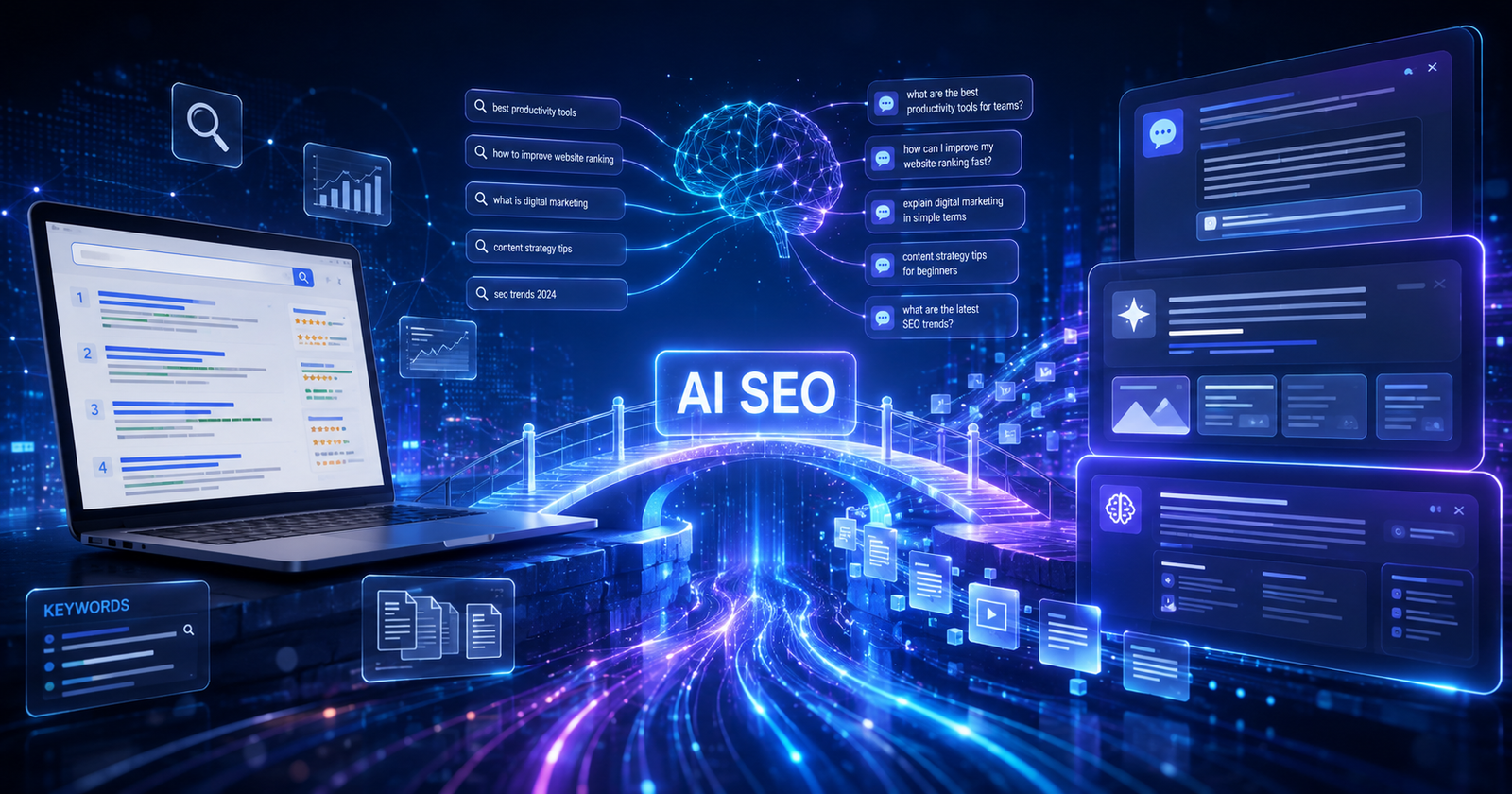
SEO used to feel simple. Write a blog post, add keywords, hit publish, and wait for Google to put you on page one. That era is over.
In 2026, people don't just search on Google. They ask ChatGPT. They use Perplexity. They let AI assistants do the research. Instead of clicking ten blue links, they get one direct answer.
If your content isn't part of that answer, you're invisible. No clicks. No traffic. No brand awareness.
This guide explains what changed, what still works, and how to build an SEO strategy that gets you found in both traditional search and AI-powered search. This is AI SEO.
AI SEO is the practice of optimising content so that AI search engines like Perplexity, ChatGPT Search, and Google's AI Overviews can find it. These tools don't just rank pages; they read, understand, and summarise them into single answers.
When someone asks, "What's the best CRM for a small business with no budget?" an AI tool pulls information from multiple websites and creates a clean answer. If your content is one of those sources, you get cited. You get visibility. Users trust your brand. When they need to go deeper or buy something, they come to you.
This is called zero-click search. The user gets their answer without visiting your site. But if your brand was cited, you still win.
AI search traffic grew 527% in just one year. That's not a trend. That's a major shift.
You've heard of SEO. GEO (Generative Engine Optimisation) is the next layer on top of it. GEO means writing and structuring content so AI tools choose it as the source for their answers.
Think of AI models like smart students writing an essay. They look across the internet for the most reliable, clearly explained, specific sources to quote. GEO is how you become that source.
Here's how to optimise for ai seo optimization:
|
Tactic |
What to Do |
Why It Works |
|
Be specific |
Say "personalised email subject lines generate 26% higher open rates" instead of "email marketing works" |
AI tools cite facts, not vague statements |
|
Answer directly |
Start each section with a one-sentence direct answer, then explain |
AI models extract the first clear answer they find |
|
Use the FAQ sections |
Add an FAQ at the bottom of every blog post |
Question-and-answer formats are most cited by AI search engines |
|
Cover topics completely |
Write one deep, thorough article instead of five shallow ones |
AI systems prefer sources that fully answer a question in one place |
A Delhi-based D2C home decor brand saw organic traffic jump from 1,200 to 4,800 visitors/month in 4 months by using SEO with AI.
Here's what they did:
Result: When people asked Perplexity "best modular kitchen organiser India," this brand's blog was cited in the AI answer. Indian businesses leveraging AI for SEO save 3x the time and budget required for manual work.
That's ai seo optimization in action.
Old keyword research: find a word people search for, write a post about it.
New keyword research: find the questions people are asking, and answer them better than anyone else.
People now ask AI tools full conversational queries like:
These are conversational queries, and they're how most people interact with AI search today.
How to find the right questions to target:
Pro tip: Don't target just one keyword per post. Write content that answers a main question AND all follow-up questions. This is called a topic cluster strategy, and it builds authority in your niche.
Most content on the internet is forgettable. AI search engines are getting very good at ignoring it.
What gets cited? Content that is:
A content framework that works:
Write like you're explaining something to a smart friend who's never heard of it before. Be genuinely helpful and clear.
On AI-generated content: Using ai seo tools like Claude or ChatGPT to help write is fine. Always add your own knowledge, review carefully, and make sure it says something useful. Copying raw AI output without editing is low quality and risky. Google penalises thin, unhelpful content regardless of how it was written.
You don't need to be a developer to understand the basics of technical SEO. Here's what matters most:
|
Task |
What to Do |
Tool |
|
Page speed |
Site should load in under 3 seconds on mobile |
Google PageSpeed Insights (free) |
|
Mobile-friendly design |
Ensure the mobile version looks flawless |
Google's Mobile-Friendly Test |
|
Let AI crawlers in |
Check robots.txt isn't blocking bots |
Googlebot, GPTBot, PerplexityBot, ClaudeBot |
|
Schema markup |
Add FAQPage schema for better AI citation |
Yoast or RankMath (WordPress plugins) |
A backlink is when another website links to yours. It's still one of the most important signals in SEO, but one link from a trusted, relevant site beats a hundred links from random blogs.
How to earn good backlinks without a big budget:
You don't need expensive software to start. Here are the ai seo tools that work for beginners:
Free tools:
Paid tools worth it:
AI SEO sounds simple until you actually try it. You need to:
Most brands don't have time for this. They're focused on what they do best, delivering their products or services.
That's where Safal Media comes in.
Safal Media is a digital marketing agency specialising in AI SEO and AI SEO optimisation. We handle everything so you can focus on your business.
What Safal Media's AI SEO service includes:
|
What We Do |
How It Helps You |
|
Conversational keyword research |
You get content targeting real questions people ask AI tools |
|
AI-optimized content writing |
Blogs structured for AI citation + human readability |
|
Technical SEO setup |
Page speed, mobile optimization, schema markup, all done |
|
AI citation tracking |
We monitor when your brand gets cited in Perplexity, ChatGPT, Google AI Overviews |
|
Link building |
Quality backlinks from trusted, relevant sites |
|
Monthly reporting |
Clear insights on traffic, citations, and ROI |
The result: You focus on your services. We take care of AI SEO. Brands working with Safal Media see organic traffic grow 3–4x within 4–6 months, with AI citations appearing within weeks.
Indian businesses that partner with Safal Media for seo with ai save 3x more time and budget compared to doing manual work internally.
AI SEO isn't the future. It's here. Brands winning in 2026 are the ones doing seo with ai from day one, not treating it as an afterthought.
You don't need to be a tech wizard. You just need to write content that's genuinely helpful, specific, and structured for both humans and AI.
Start small. Pick one topic. Write one killer post. Watch how Perplexity and Google AI Overviews treat it. Then repeat.
Or, skip the learning curve entirely. Safal Media handles ai seo optimization for you. You focus on your services. We take care of everything else.
SEO compounds. In 2026, that work includes getting cited by AI, not just ranked on Google.
Let Safal Media get your brand found.