Digital marketing for restaurants refers to using online channels, including search engines, social media, food delivery platforms, email, and AI-driven tools, to attract diners, increase orders, and build long-term brand loyalty. In India's hyper-competitive food industry, a structured digital marketing strategy for restaurants is no longer optional; it is the difference between a thriving table and an empty one.
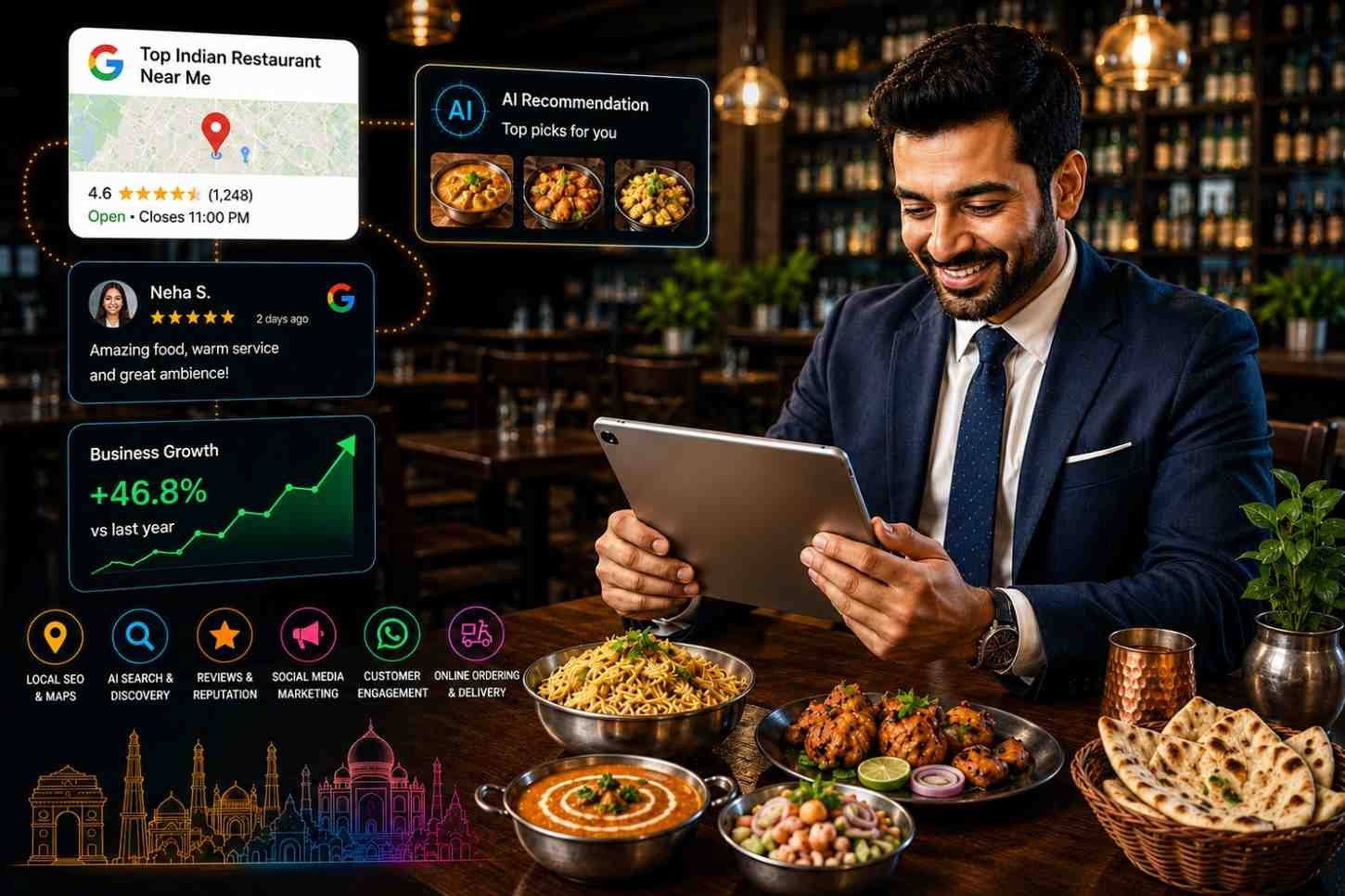
In 2026, restaurant discovery happens across five surfaces simultaneously:
- Google Search & Maps
- AI Answer Engines (ChatGPT, Gemini, Perplexity, Google AI Overviews)
- Short-form video (Instagram Reels, YouTube Shorts)
- Food delivery apps (Zomato, Swiggy)
- WhatsApp & loyalty channels
A restaurant that optimises for only one of these surfaces is leaving the majority of its potential customers on the table.
Why Traditional SEO Is No Longer Enough for Restaurants
Between 2024 and 2025, Google's AI Overviews triggered for over 13% of all search queries globally, with food and local searches among the most impacted categories. When an AI summary appears at the top of a search result, click-through rates on traditional organic links drop from ~7% to as low as 2%.
This means:
- Ranking #1 on Google is not enough if you are not inside the AI-generated answer
- Backlinks alone don't build AI visibility, structured, authoritative, answer-format content does
- Voice search and conversational AI are how a growing segment of India's urban diners discover where to eat
The new framework that every restaurant marketer must understand is AIO + AEO + GEO.
Understanding AIO, AEO & GEO for Restaurant Marketing
AIO: AI Overview Optimization
AIO means structuring your website, Google Business Profile, and content so that Google's AI Overview feature cites your restaurant or your agency's restaurant content as a trusted source. Google's AI Overviews are live in 200+ countries and summarise the top answers before listing any website links.
For restaurants, AIO wins come from:
- A fully complete and verified Google Business Profile
- FAQ content on your website using structured data (Schema markup)
- Consistent NAP (Name, Address, Phone) data across all platforms
- Regular content updates that signal active relevance
AEO: Answer Engine Optimization
AEO is the practice of crafting content that directly answers the specific questions diners ask — before they even click a link. Think of it as writing for the answer box, not for a web page.
Common restaurant AEO queries in India include:
- "Best biryani restaurant near me open now"
- "Which restaurant in [city] has the best rooftop dining?"
- "Is [restaurant name] open on Sunday?"
- "What is the average cost for two at [restaurant]?"
AEO best practices for restaurants:
- Use FAQ sections with direct, concise answers (under 50 words each)
- Add the FAQ Schema and the LocalBusiness Schema to your website
- Keep your Google Business Profile Q&A section updated
- Write menu descriptions that match natural language questions
GEO: Generative Engine Optimization
GEO is about making your restaurant brand citable by AI models like ChatGPT, Perplexity, and Google Gemini. When a user asks an AI tool "recommend a good coastal seafood restaurant in Mumbai," GEO determines whether your brand gets mentioned or completely skipped.
GEO for restaurants requires:
- Publishing authoritative, fact-dense content that AI models can extract and verify
- Getting mentioned on high-authority platforms (Zomato blog, food media, PR)
- Consistent brand entity signals across the web (same name, same description, same cuisine tags)
- Accumulating verifiable reviews with specific keywords (dish names, locality, experience descriptors)
The 10 Best Digital Marketing Strategies for Restaurants in India
1. Google Business Profile: Your Most Powerful Free Asset
Your Google Business Profile (GBP) is the single highest-ROI asset in any digital marketing strategy for restaurants. It powers your presence on Google Maps, local search results, and directly feeds Google's AI Overview engine.
What to do in 2026:
- Upload fresh photos every week (exterior, interior, food, team)
- Update your hours for every Indian holiday; incorrect hours cause 62% of potential diners to avoid a restaurant entirely
- Use the "Posts" feature to announce offers, new menu items, and events
- Respond to every review, positive or negative, within 24 hours
- Maintain a fully answered Q&A section with your own questions and answers
- Add your menu with item names, descriptions, and prices
- Enable Google Reservations and Google Ordering integrations
Why it matters for AIO/GEO: Google's AI Overviews pull directly from GBP data. Incomplete profiles are invisible to AI recommendations.
2. Zomato & Swiggy Listing Optimisation: The Indian-First Strategy
India's restaurant digital marketing landscape is unique because Zomato and Swiggy function as search engines in their own right. Millions of Indians don't Google "restaurants near me", they open Zomato or Swiggy directly.
Optimisation checklist:
- Use high-resolution food photography (minimum 1080px), listings with professional images receive significantly higher click-through rates
- Write menu item descriptions that include ingredients, preparation style, and dietary tags (vegan, Jain, gluten-free)
- Enable Zomato Gold / Swiggy One integrations for premium visibility
- Maintain a minimum 4.0-star rating consistently
- Run Zomato Ads and Swiggy Ads during peak ordering hours (12–2 PM and 7–10 PM)
- Respond to every Zomato/Swiggy review, it directly impacts your algorithmic ranking
Pro tip from Safal Media: Treat your Zomato listing as a product page, not a directory listing. Every field you fill is a keyword signal to their internal search algorithm.
3. Short-Form Video: Reels, Shorts & the Visual Discovery Engine
India's Gen Z and millennial diners do not Google restaurants first. They discover them through Instagram Reels and YouTube Shorts. This is not a trend; it is the primary discovery channel for urban diners under 35.
High-performing video formats for Indian restaurants:
- "Making of" videos: show the prep of your signature dish. Authenticity outperforms polish here.
- Trending audio + food transitions: pairing popular Indian audio tracks (like viral Bollywood or regional beats) with satisfying plating shots drives 3x higher organic reach
- "POV: You're at [your restaurant]" formats: first-person immersive walkthroughs
- Chef story content: humanising the kitchen creates an emotional connection
- Festival specials: Diwali thali, Eid specials, Navratri menus with timely content
Platform strategy:
- Instagram Reels: post 4–5 times per week, prioritise Saves and Shares over Likes
- YouTube Shorts: repurpose top-performing Reels, YouTube's algorithm rewards consistency
- Google Maps now shows video content in restaurant listings, upload videos to GBP
4. WhatsApp Marketing: India's Most Underused Restaurant Channel
With over 530 million users in India, WhatsApp is the most direct line to your existing customer base. Most restaurants ignore it completely.
WhatsApp Business API strategy for restaurants:
- Build an opt-in customer list through dine-in QR codes, Swiggy/Zomato order confirmations, and website sign-ups
- Send personalised weekly offers (not daily, avoid unsubscribes)
- Use WhatsApp Broadcast lists for new menu launches and event invites
- Enable WhatsApp ordering for direct orders (bypassing Zomato/Swiggy commission)
- Run "WhatsApp exclusive" deals to incentivise list growth
Why this matters: Every direct order via WhatsApp saves 20–30% in platform commission. For a restaurant doing ₹5L/month on delivery apps, even a 15% shift to direct orders recovers ₹1L+ per month.
5. Hyperlocal Social Media: Community Before Content
India's food culture is deeply local. A restaurant in Koramangala, Bangalore, has a completely different social media personality requirement than one in Colaba, Mumbai. Generic national-level content performs poorly.
Hyperlocal social media framework:
- Use geo-tagged Instagram and Facebook posts that name your neighbourhood explicitly
- Engage with local community groups on Facebook, colony groups, housing society groups, expat groups
- Partner with local micro-influencers (5,000–50,000 followers) in your city who have highly engaged, targeted audiences
- Create content around local festivals, events, and cultural moments specific to your city or neighbourhood
- Tag and collaborate with nearby complementary businesses (breweries, event spaces, retail stores)
Micro-influencer ROI fact: A 2025 food influencer study found that micro-influencers in the food category generate 7x higher engagement per rupee spent compared to macro-influencers with 500K+ followers.
6. AI-Powered Personalisation: The New Loyalty Engine
India's leading food delivery platforms, Swiggy and Zomato, already use AI to personalise every user's homepage, push notifications, and suggestions. Restaurants that feed AI-friendly signals win more of these personalised recommendations.
What restaurants can do:
- Use CRM tools (or even simple Google Sheets-based tracking) to segment customers by order frequency, average spend, and cuisine preference
- Send personalised messages for birthdays, anniversaries, and customer milestones
- Use loyalty programs tied to your POS, rewarding points per visit keeps customers returning and increases average order value
- In 2025, loyalty program members generated 5–7x more revenue per rupee spent on the program than non-members
AI tool recommendations for Indian restaurant marketers:
- ChatGPT / Claude — for drafting social captions, WhatsApp copy, and email sequences
- Canva Magic Write — for generating on-brand visual content at scale
- Replit / Glide — for building simple no-code loyalty apps
7. Online Reputation Management: Reviews as a Ranking Signal
In India's restaurant market, online reviews are both a conversion signal (deciding whether a new diner chooses you) and a ranking signal (determining where you appear on Zomato, Google Maps, and in AI recommendations).
Reputation management framework:
- Ask every satisfied diner for a Google review, train front-of-house staff to do this systematically
- Never offer incentives for reviews (this violates Google's policies), but you can make the ask personal and genuine
- Respond to negative reviews with empathy, a specific resolution, and a soft invite to return
- Use Zomato's review responses strategically; responses that include dish names and location keywords improve your algorithmic visibility
- Track review sentiment trends monthly; sudden drops in sentiment indicate operational issues, not marketing issues
AEO insight: Reviews that mention specific dish names, locality descriptors, and occasion types (e.g., "great place for a corporate lunch in Bandra") are gold for AI answer engines. Encourage this level of specificity in your review request prompts.
8. Content Marketing for AI Visibility: Blog, FAQ & Schema
This is the strategy that most restaurant marketers in India completely skip, and it is exactly why the ones who do it own disproportionate AI visibility.
Content types that win AI citations:
- "Best [cuisine] in [city]" articles published on your own website, yes, even restaurants should have blogs
- FAQ pages that answer every question a potential diner might ask about your restaurant, menu, or cuisine
- Dish origin stories and ingredient spotlights, AI engines love verifiable, specific, educational content
- LocalBusiness Schema and Restaurant Schema markup on every page
- Menu Schema with full dish names, descriptions, prices, and dietary attributes
GEO-winning content formula: Write content that is specific, factual, and answers a real question. A 600-word piece titled "What Makes Dal Makhani Different in Delhi vs Mumbai, And Where to Eat the Best" will generate more AI citations for a North Indian restaurant than a generic "Our Story" page.
9. Paid Digital Advertising: Precision Over Volume
Paid advertising for Indian restaurants in 2026 is about precision targeting, not mass reach. With AI-powered ad platforms, the ability to reach only the right people at the right moment has never been higher.
Effective paid channels for Indian restaurants:
Google Performance Max Ads
- Target users searching "restaurants near me," cuisine-specific queries, and occasion-based searches
- Use your GBP data as the creative feed, and Google will auto-generate ads from your photos and descriptions
- Set geo-radius targeting to 3–5 km from your restaurant
Meta (Instagram + Facebook) Ads
- Retarget website visitors and Instagram profile visitors with compelling video content
- Use Custom Audiences from your WhatsApp/email list for loyalty promotions
- Run lookalike audience campaigns to reach diners similar to your best existing customers
Zomato & Swiggy Promoted Listings
- Run during peak hours only (12–2 PM and 7–10 PM) to maximise conversion
- Increase bids during weekends and festival seasons
10. Email Marketing & CRM: The Highest ROI Channel Nobody Uses
Email marketing delivers an average return of ₹3,000 per ₹100 spent, the highest ROI of any digital channel. For Indian restaurants, this translates directly into repeat covers and orders.
Restaurant email marketing framework:
- Collect emails at checkout, via your website, and through QR codes at the table
- Send a welcome sequence to new subscribers with a first-visit offer
- A weekly or fortnightly newsletter with: new dishes, stories from the kitchen, upcoming events, and a soft CTA to book or order
- Re-engagement campaigns for customers who haven't visited in 60+ days
- Birthday and anniversary automations, these consistently generate the highest open rates and conversion rates of any restaurant email type
Digital Marketing Strategy for Restaurants: A Framework by Safal Media
At Safal Media, we don't just put your restaurant on the map; we make sure it shows up wherever your next customer is looking. And in 2026, that means AI tools like ChatGPT, Gemini, and Google AI Overviews, not just Zomato and Swiggy.
Here's what most restaurants are missing: AI tools don't recommend just anyone. They recommend restaurants with strong, consistent signals across the web, good reviews, media mentions, optimised content, and an active online presence. That's exactly what we build for you:
- Accurate, optimised listings on Google Maps, Zomato, and Swiggy
- Weekly food content on Instagram, YouTube, and WhatsApp
- Blog articles and FAQ pages written specifically to appear in AI search results
- Features in food publications that signal credibility to AI engines
- Targeted ads on Google, Meta, and Zomato when hungry customers are most active
The restaurants getting recommended by ChatGPT today didn't get there by accident. They invested in the right kind of visibility. At Safal Media, that's our job, making sure yours is one of them.
Conclusion
The restaurants that will dominate India's food market over the next three years are not the ones with the biggest marketing budgets. They are the ones that show up wherever their next customer is asking, whether that's Google Search, Google Maps, Zomato, Instagram Reels, or a ChatGPT answer box.
A well-executed digital marketing strategy for restaurants in 2026 means building for all five discovery surfaces simultaneously: search engines, AI answer engines, social video, delivery platforms, and direct channels. Each layer supports the others, creating a compounding visibility advantage that is very hard for competitors to displace.
At Safal Media, we help Indian restaurants build exactly this kind of multi-surface digital presence, combining AIO-ready content strategy, AEO-structured web assets, GEO-optimised brand authority, and high-performing social media execution.